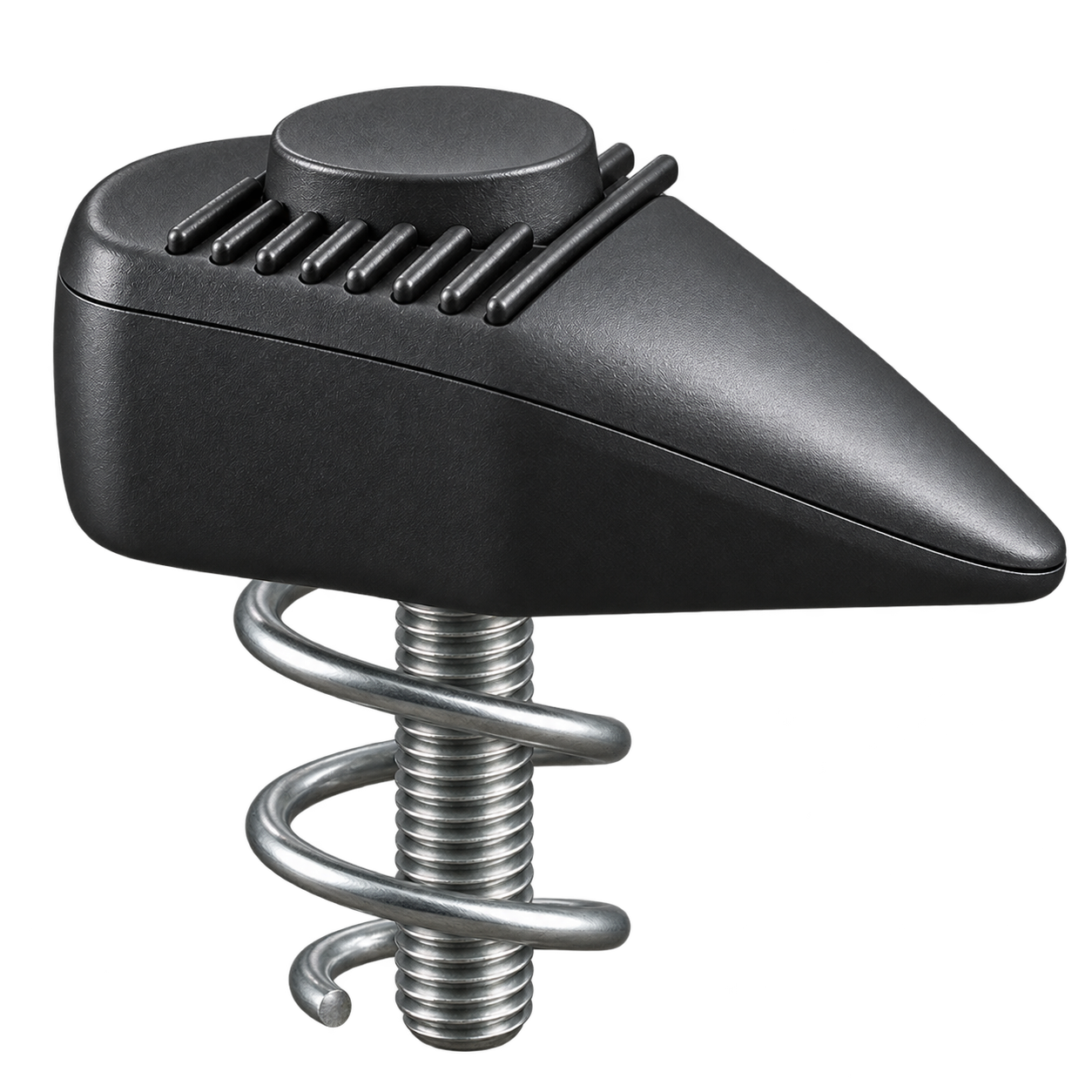
A retaining component that turns to engage or release a panel. In this screw-and-spring example, rotation of the body and axial screw adjustment are separate actions.
Retaining body, screw and spring. Illustrative view of the component.
infoWhat it does
The retaining nose turns into or out of engagement with the corresponding part of a door assembly. In the illustrated arrangement, screw rotation changes axial position while the spring changes length along the same axis.
Retention and gasket compression depend on the complete door, mating surface and adjustment. The isolated clamp does not demonstrate a door seal or a safety lock. Follow the unit's service procedure before releasing a panel.
categoryKey parts
Body and retaining nose
The part that turns into the retaining position. Its engagement and clearance must match the actual mating surface.
Adjustment screw
Rotation produces movement along the screw axis. The example shows the principle; it does not specify the permitted adjustment or tightening torque.
Spring
Changes length as the axial setting changes. Spring stiffness and the resulting retaining force require data for the selected component.
checklistWhat to check when selecting
Check the panel thickness, mounting arrangement and position of the mating surface.
Confirm retaining-nose engagement, rotation clearance and access to the adjustment screw throughout the service-door movement.
Confirm the adjustment range, tightening torque, retained load and gasket compression against the exact component and door documentation.
Check material, corrosion resistance, cleaning conditions and any required safety retention. The educational model does not establish these ratings.
view_in_arExplore the mechanism in 3D
Use the separate controls for clamp rotation and screw adjustment. Watch the screw move along its axis and the spring change length; rotate the view to inspect the retaining nose.
Rotating door clamp
A clamp that turns to engage or release a panel. In the illustrated screw-and-spring arrangement, turning the screw changes axial position; the spring changes length along the same axis.
Drag with a mouse to rotate. On touch screens, swipe horizontally to rotate or vertically to scroll the page. Use + and − to zoom. With the model focused: 1 = front, 2 = side, 0 = perspective view; Escape closes the model.
Turn the clamp to inspect its retaining nose. The second control rotates and moves the screw along its axis while the spring changes length. Rotation and screw adjustment are shown separately; this model does not include a service door. Small fastener details are simplified.
This is an educational mechanism without a service door. Small fastener details are simplified. Motion does not establish permitted travel, spring force, tightening torque or compatibility with a particular unit.