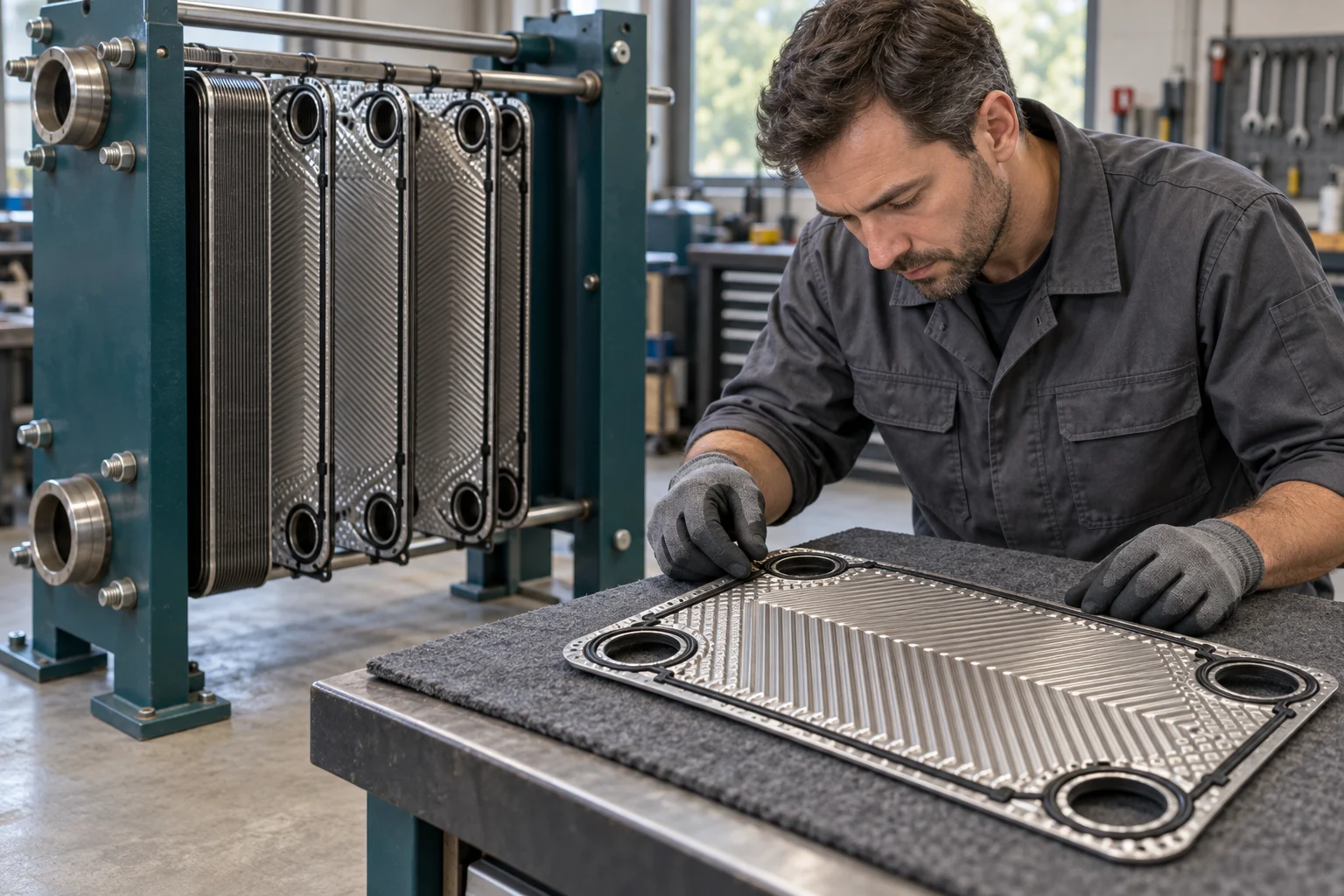
Illustration: inspecting plates of a gasketed heat exchanger before repair.
Photographs and a description help identify the construction and plan the inspection. The cause of a leak, metal condition and repairability require inspection and appropriate tests.
routeWhere to start
water_drop
Leak or fluid mixing
Record the symptom and when it appeared. A qualified technician must safely isolate the exchanger before disassembly.
manage_searchFollow the evidence, one step at a time
Observe
What changed, and under which conditions?
Identify
Which construction and which circuit?
Verify
What inspection can establish the cause?
thermostat
Heating or cooling has fallen
Compare temperatures, flows, pressure drop and filter condition. The exchanger itself is not always the cause.
swap_horiz
Compare repair and replacement
Check material condition, access, spare parts and the consequences of another failure. Prepare information for both options.
categoryConstruction determines the repair approach
Choose the construction. Each family below shows typical issues, possible work and decision limits.
A symptom is an observed change. A cause is a defect or condition that still needs verification. Keep them distinct.
thermostat“It heats less” describes a symptom, not its cause
The observation
Record the changed temperatures and the operating situation.
The comparison
Check available flow and pressure readings against a comparable earlier condition.
This example organizes the inspection; it does not diagnose fouling or damage.
water_dropLeaks, moisture or oil traces
Gaskets, tubes, headers or joints may be damaged; distinguish condensation from a leak.
For assessment: Photograph the unit and the affected area. Record fluid, pressure, temperature and when the leak appears.
thermostatReduced heat-transfer duty
Check fouling, flow, trapped air, filters and controls. One temperature reading is not sufficient.
For assessment: Record both fluids’ inlet/outlet temperatures, flows or available measurements, and cleaning history.
speedIncreased pressure drop
Blockage, deposits or a changed flow may be responsible. Compare equivalent operating conditions.
For assessment: Provide pressure drop, pump/fan operating conditions, connection arrangement and filter condition.
ac_unitIcing and freeze damage
Surface icing and structural damage after freezing are different cases. Assess flow, fluid and protective controls.
For assessment: Provide photographs, the sequence of events, temperatures, airflow conditions and the working fluid.
sync_problemRepeated failure
The cause may remain in operating conditions, material compatibility, water hammer, vibration, corrosion or freezing.
For assessment: Record dates, previous repairs, replaced parts and changes in operation.
compare_arrowsFluid mixing
The separating surface may leak. An external visual inspection cannot rule this out.
For assessment: Describe the evidence of mixing and both fluids. Agree testing and further operation with the responsible specialist.
search
Where to look for causes
Fluid and deposits → materials and corrosion → flow and temperatures → pressure and water hammer → installation, vibration and previous assembly. Inspect the system as well as the exchanger.
troubleshootOne observation: pressure drop has increased
filter_altPossible deposits or blockage
Check the condition of the channels and filters.
waterPossible change in flow
Compare flow and pump or fan operating conditions.
These are possible explanations, not a diagnosis. Compare equivalent operating conditions before choosing the work.
tunePrepare for diagnosis
This tool collects inputs, suggests what to verify and prepares a request summary. It does not calculate test pressure, repair price or remaining service life.
Start with construction and symptoms. If you do not know the type, select “Not sure”.
These are comparison criteria, not automatic permission to repair. A decision depends on inspection and the requirements of the particular exchanger.
alt_routeThe same visible leak can lead to different decisions
One accessible area
Assess material condition, a suitable method and the ability to verify the result.
Several areas or recurrence
Compare wider damage, the system cause and the consequences of another failure.
When to assess repair and when to prepare replacement
Criterion
Supports assessing repair
Supports comparison with replacement
Extent
One accessible defect.
Several damaged areas or recurring leaks.
Material
Condition and compatibility confirmed.
Corrosion, erosion, cracks or deformation.
Verification
The result can be verified after work.
The defect is inaccessible or repair quality cannot be verified.
Spare parts
Compatible parts and documentation are available.
Material is unknown or required parts are unavailable.
Consequences
The shutdown window and risk are acceptable.
Another failure would be critical to the process.
Economics
Repair, testing and downtime have been compared.
Cost and risk approach or exceed replacement.
Replacement requires more than matching dimensions: connections, materials, fluids, operating conditions and allowable pressure losses are also needed.
What will demonstrate that the agreed work is complete?
manage_search
1. Inspection and defect assessment
Record identification, symptoms and operating conditions; assess the damaged area, surface condition and access.
water
2. Cleaning
Choose disassembly, mechanical or chemical cleaning to suit construction and materials. CIP is cleaning without disassembly, where the design allows it.
build
3. Restoration
Agree gasket, plate, tube or section replacement; verify material compatibility and assembly instructions.
fact_check
4. Verification
Apply an agreed test procedure. Record leak tightness and operating performance under comparable conditions.
assignment_turned_in
What the result should document
Initial defect, photographs, identification and agreed limitations.
Work completed and materials or parts replaced.
Test method and parameters, observed result and remarks.
Further operating conditions and measures to prevent recurrence.
Do not choose pressure-test settings or cleaning chemicals from generic website advice. They depend on documentation, materials, fluid and an approved procedure; a qualified specialist performs the work.
menu_bookTerms explained
Defect assessment
Inspection to establish damage, its extent and repair limitations.
Leak tightness
The ability to contain fluid within its circuit under specified test conditions.
Retubing
Replacing tubes in a tube bundle where the design permits.
Regasketing
Installing compatible gaskets while checking plates, arrangement and assembly dimensions.
Heat-transfer duty
Heat transferred per unit time at a defined operating condition.
Pressure drop
The inlet-to-outlet pressure difference; comparison requires an equivalent flow.
photo_cameraInformation to prepare
photo_camera
Overall view and connections
Show the entire exchanger, connections and access for removal.
photo_cameraThree views answer three different questions
Overall
What is the construction and how is it connected?
Identification
Which unit and documentation are involved?
The defect
Where is the observed problem?
badge
Nameplate and documents
Provide readable identification, documentation or a drawing if available.
search
Damaged area
A close-up and a wider view; describe when the symptom appears.
Also useful: fluids, temperatures, pressure, flow, pressure drop, cleaning and repair history, and the available shutdown window. Missing information can be marked as unknown.
assignmentRequest an assessment
Describe the task and prepare a request. If site submission is unavailable, copy the text or open it in email; attach photographs to the email manually.
A request is accepted only after the server responds with a request number. Preparing or copying an email does not send it.
Compare the complete scope, including verification.
Cost depends on construction, fouling or damage, access, materials, disassembly, testing and logistics. Agree the final scope after reviewing inputs and assessing defects.
Compare work, spare parts, verification, transport and downtime separately.
Clarify deliverables and the conditions under which an estimate may change.
Timing and warranty terms need confirmation for the specific scope; a photograph does not establish them.
helpFrequently asked questions
Can a photograph establish the price?
Photographs help identify construction and plan inspection. Hidden damage, materials, work scope and access may change an estimate.
Does flushing always restore performance?
No. Cleaning alone does not resolve flow, trapped-air, controls or damage issues. Compare results under equivalent conditions.
Can every heat exchanger be repaired?
No. Construction, material condition, access and the ability to verify the result limit repairability. Replacement may be more appropriate.
What if documentation or the type is unknown?
Prepare overall and connection photographs, identification and a symptom description. Mark unknown values as unknown; do not guess allowable pressures.
Why did the problem return after repair?
The underlying cause may remain: operating conditions, fluid composition, corrosion, freezing, water hammer or vibration. Review previous work and inspect the system.
Will inputs survive a language switch?
The header language switch translates without reloading: entered fields and selected files stay in place. After a full reload, select the files again.