Equipment reference
Circulation pumps
Circulation describes the duty: moving a heat-transfer fluid around a circuit. It does not by itself define rotor type, mounting position or number of stages.
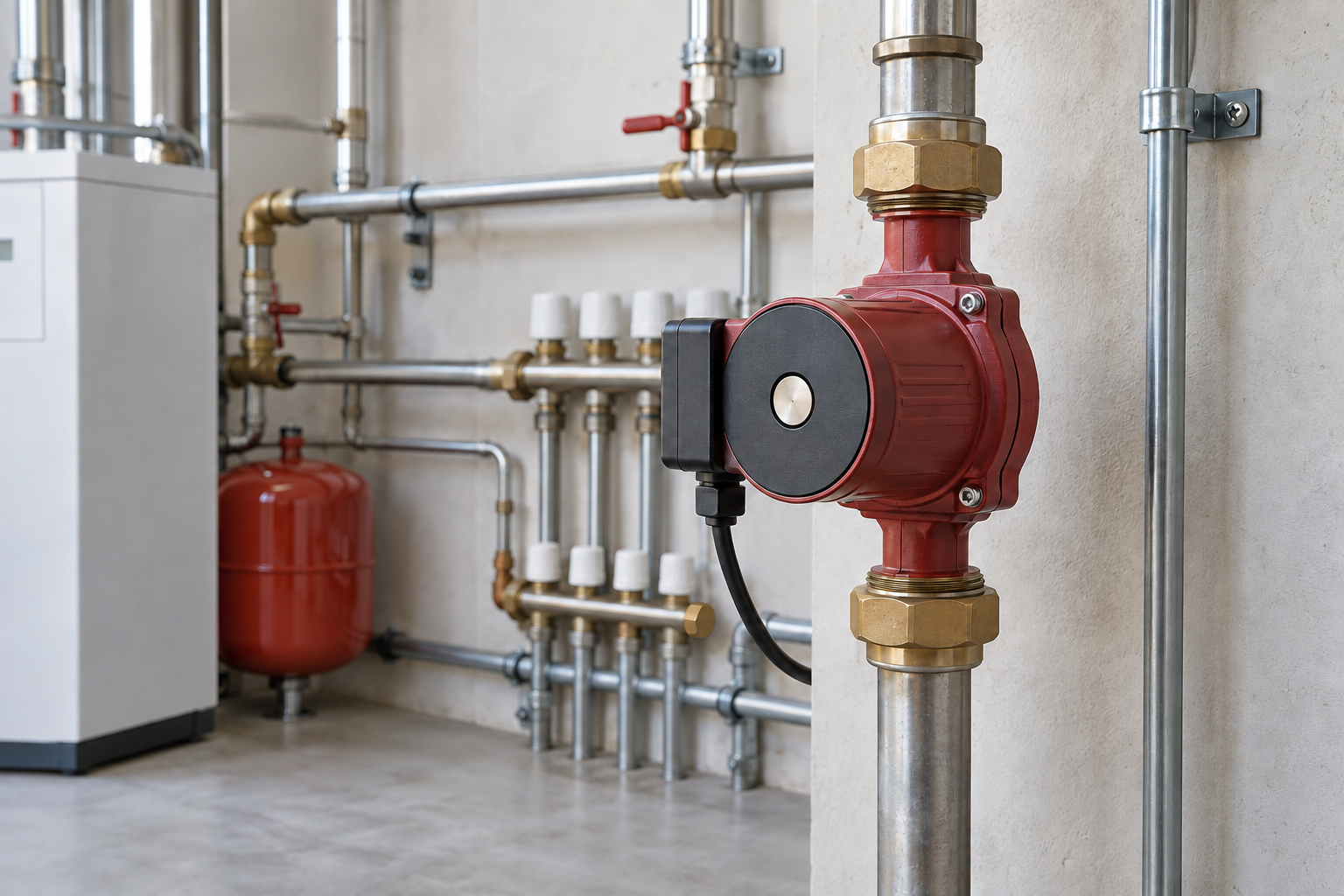
Closed-circuit duty
In a filled closed circuit, the pump mainly overcomes flow resistance. Building height is not simply added as circulation head: the rising and descending columns balance. Static system pressure still matters for filling, equipment limits and suction conditions.
Circulation duty, in-line layout and rotor
A wet rotor operates in liquid, usually separated from the stator by a can. A dry rotor remains outside the pumped liquid. These descriptions concern the motor construction; horizontal or vertical describes orientation, and submerged describes installation.
Many circulation installations use in-line pipe connections, but in-line does not imply a wet rotor. Check the hydraulic duty, connection layout, permitted shaft orientation and rotor construction independently.
The rotor is the rotating motor part; the stator is the stationary electromagnetic part. The can is a separating sleeve that keeps the stator side isolated from the wetted rotor.
Flow and control
Heating or cooling duty and the chosen temperature difference determine the required circulation flow. A variable-speed drive can adapt output to demand; constant or proportional differential-pressure control is chosen for the circuit and valve behaviour. Record the design and part-load duties.
Water, glycol and potable circuits
Record glycol type and concentration, temperature range, water quality and seal materials. A heating circulator is not automatically suitable for potable-water recirculation. Fluid properties and the required hygienic approvals belong to the exact configuration.