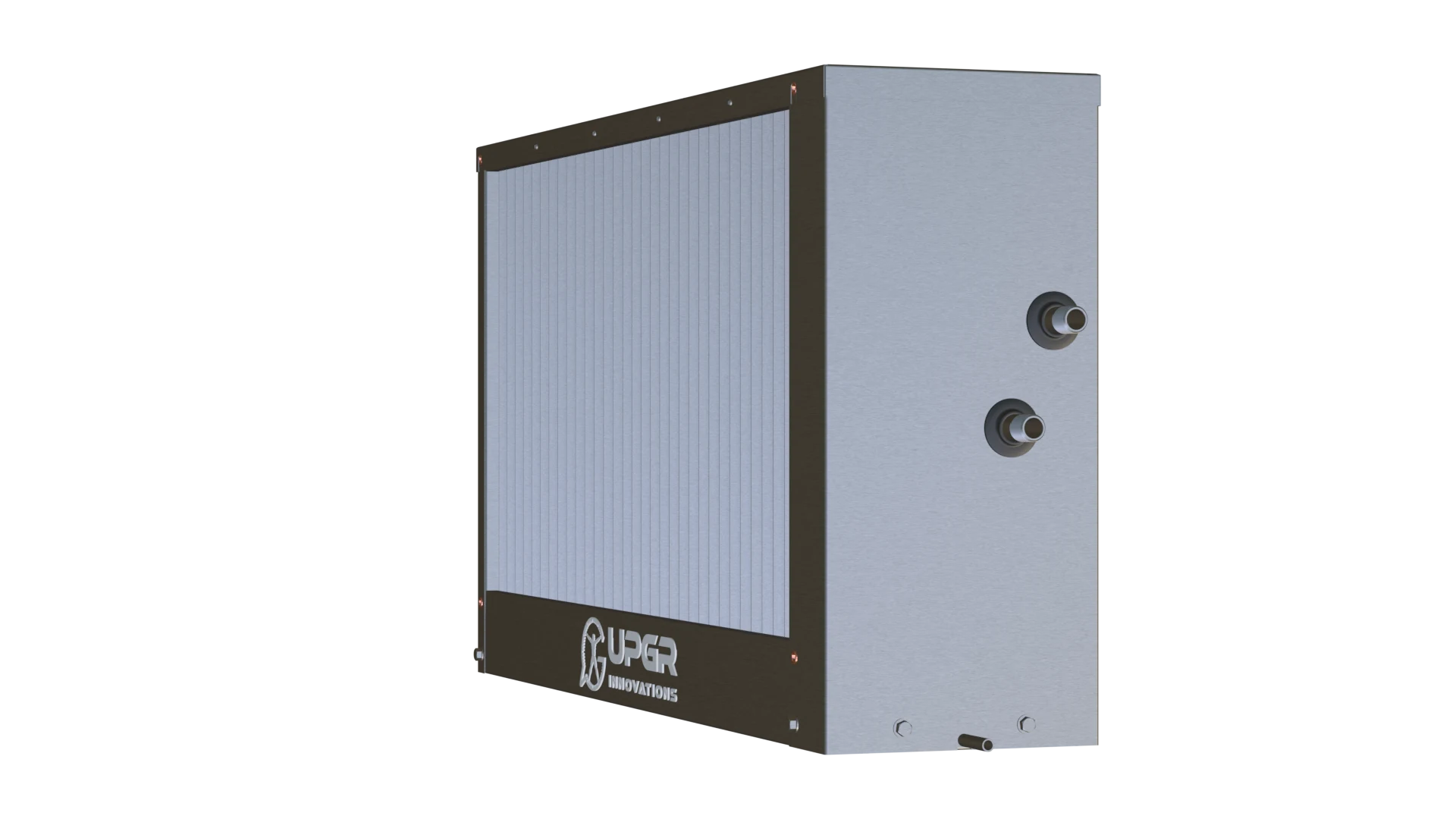
Owned UPGR archive 3D visualization of КВО 100-50. The view shows the exterior of a water cooling coil; internal circuits, operating conditions and the ordered configuration are defined during selection.
01
Dry and wet cooling
A dry operating condition has no condensation on the coil surface. When moist air is cooled sufficiently, some of its moisture may condense. Entering air temperature alone therefore does not fully describe the duty: humidity is needed to assess cooling and dehumidification. Establish the condition from the specified duty, not from the product name.
IN PRACTICE
Cooling and condensate: two different checks
Moisture removal depends on air humidity and surface temperature. Not every cooling duty produces condensate.
01
Air entering
Temperature, humidity and flow.
02
Cooling surface
Air loses heat; moisture may condense.
03
Collection + drain
Check the pan, drainage and carryover conditions.
The image shows an archive KVO water cooling coil. Glycol duty requires a separate selection; pan, drainage and supply scope are agreed for the order.
02
Water and glycol solutions
The word glycol does not specify the fluid mixture. Provide the solution type, concentration and operating temperatures. Thermal performance and water-side pressure drop are assessed for that declared fluid. Two coils are not automatically interchangeable because both provide liquid cooling or have the same face area.
03
Condensate and supply scope
Where condensation is possible, review collection and drainage as part of the equipment arrangement. Do not assume that a drain pan or drainage components are included with the coil. Check coil position, airflow direction, available space and connections. For replacement, photographs of the surrounding installation are useful alongside images of the finned surface.
REVIEW THE RESULT
What to check in a cooling coil selection
Entering and leaving air
Provide entering air temperature and humidity, together with the required leaving condition. The result should identify the dry or wet operating condition and the resulting air state, as well as capacity.
Exact fluid specification
For glycol, state the type and concentration; for every duty, provide temperatures and the known liquid flow. Compare alternatives using the same fluid, with its composition and pressure drop recorded on the selection sheet.
Condensate drainage
For wet operation, check the coil position, drain pan and condensate drainage path within the unit. The supply scope should identify which components remain in place and which need to be included in the enquiry.
SELECTION INPUTS
Inputs to prepare
Entering airflow, air temperature and humidity.
Required leaving air condition or cooling duty.
Water, or the glycol type and concentration.
Liquid temperatures and flow rate if known.
Air-side and liquid-side pressure-drop limits.
Installation envelope, connections and condensate drainage arrangement.
What do you need to do?
Select a new coil
Define operating conditions first. The input checklist above describes the data needed for this application. The enquiry form adapts to the selected duty; it does not calculate a coil rating.
Add the equipment nameplate, photographs, overall and finned dimensions, airflow direction, connections and access constraints. Matching the envelope alone does not confirm performance or compatibility.
Separate fixed interfaces from dimensions open to change. Attach the current drawing revision, duty points, material requirements, quantity and acceptance criteria. Manufacturing feasibility is confirmed for the specific specification.
Final performance, materials and compatibility require a project-specific selection and an approved drawing.
Questions about this application
Why is humidity needed for a cooling coil?
Humidity helps establish whether cooling will involve condensation and dehumidification. The same air temperatures can represent different heat and moisture removal duties.
Can water be replaced with glycol without reviewing the selection?
The change needs to be checked for the specific mixture and duty. Naming glycol in an enquiry does not establish that an existing coil will retain the same capacity and pressure drop.
Is an air cooling coil the same as a chiller?
No. This page describes a heat exchange section through which air and liquid pass. The source of chilled liquid and the other system equipment have their own specifications and supply boundaries.