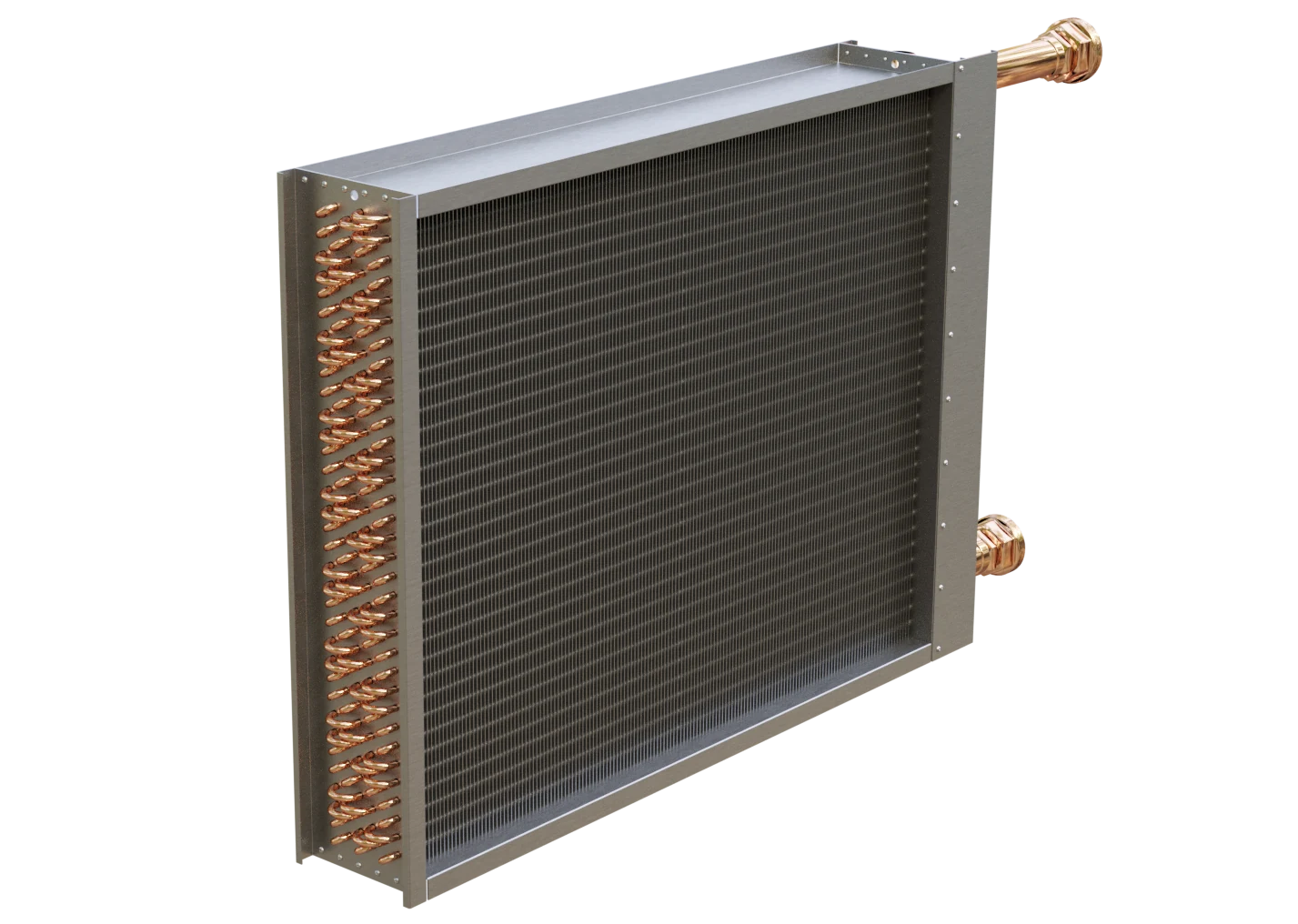
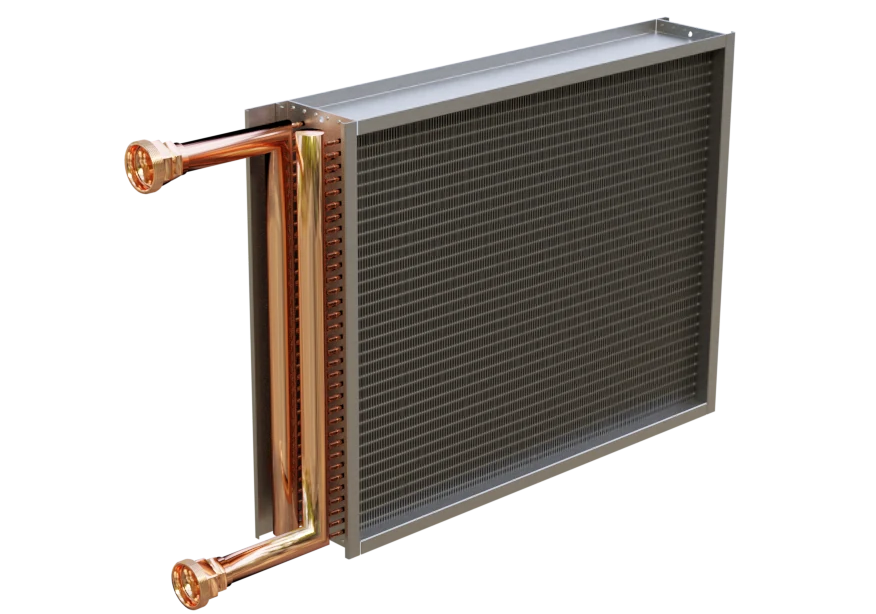
Liquid coil — finned faceUPGR archive 3D visualization of a liquid coil. The view shows the finned surface and return bends; dimensions, fluid and internal circuits are specified for the project.Connection-side viewArchive 3D connection-side view. Connection positions are illustrative; no dimensions or hydraulic circuit are established by this image.
01
One fluid, different duties
Water is used in finned coils for both air heating and cooling. State the fluid and the function separately in the enquiry. If the unit changes duty seasonally, provide each operating condition and identify whether one coil or several separate coils serve those duties.
IN PRACTICE
Two views of a liquid coil
The archive views explain the finned block and connection side. They do not define a selected product.
01
Finned face
The broad face and frame show the part that fits the air passage.
02
Connection side
The second view makes the headers and projecting connections easier to see.
03
Project data
Provide the available opening, connection positions and water operating conditions.
Archive geometry is illustrative. Confirm dimensions and the circuit against the project drawing.
02
Describe the water and its circuit
Identify the water source, circuit purpose and any known additives or treatment. For an existing system, include an available analysis or its fluid specification. Material suitability is reviewed against that information; the term water coil alone does not establish suitability for drinking or process water.
03
Operating points rather than one capacity
For each duty, link water temperatures to airflow and the required result. Add water flow or available pump information where known. Mark values as measured, taken from the previous design or still to be confirmed so that the selection can be compared with the actual system.
04
Replacement with existing interfaces
For a replacement, retain the nameplate, drawing, finned and casing dimensions, connection positions and photographs of both sides. List the interfaces that must remain fixed and say whether water conditions will change. A similar appearance does not replace checking this information.
REVIEW THE RESULT
Checks for the water circuit
A clear fluid specification
Record water source, composition and additives; keep unknown information separate from assumptions of pure water.
Duties linked to the circuit
List the operating points for heating and cooling, and identify which coil and season each selection covers.
Replacement constraints recorded
Separate fixed dimensions, connections and interfaces from parameters that may change during selection.
SELECTION INPUTS
Inputs to prepare
Water circuit purpose and heating or cooling duties.
Water source, known treatment and additives.
Water temperatures and flow for each operating condition.
Airflow, entering air condition and required result.
Allowable pressure drops and available system information.
For replacement: nameplate, drawing, connections and fixed interfaces.
What do you need to do?
Select a new coil
Define operating conditions first. The input checklist above describes the data needed for this application. The enquiry form adapts to the selected duty; it does not calculate a coil rating.
Add the equipment nameplate, photographs, overall and finned dimensions, airflow direction, connections and access constraints. Matching the envelope alone does not confirm performance or compatibility.
Separate fixed interfaces from dimensions open to change. Attach the current drawing revision, duty points, material requirements, quantity and acceptance criteria. Manufacturing feasibility is confirmed for the specific specification.
Final performance, materials and compatibility require a project-specific selection and an approved drawing.
Questions about this application
Does a water coil always heat air?
No. Here the fluid defines the family, while heating or cooling defines the duty. Specify the required function and conditions separately.
Can an existing coil be retained with different water temperatures?
This requires a selection review. Provide the previous and new conditions together with the coil data; unchanged dimensions do not establish unchanged performance.
What if the water composition is unknown?
Mark the composition as unknown and provide the available source and treatment information. Do not replace missing information with an assumption of pure water.