Start with the exact refrigerant designation and the coil's function. The general term refrigerant coil does not specify an evaporator, condenser or a coil intended for multiple operating modes.
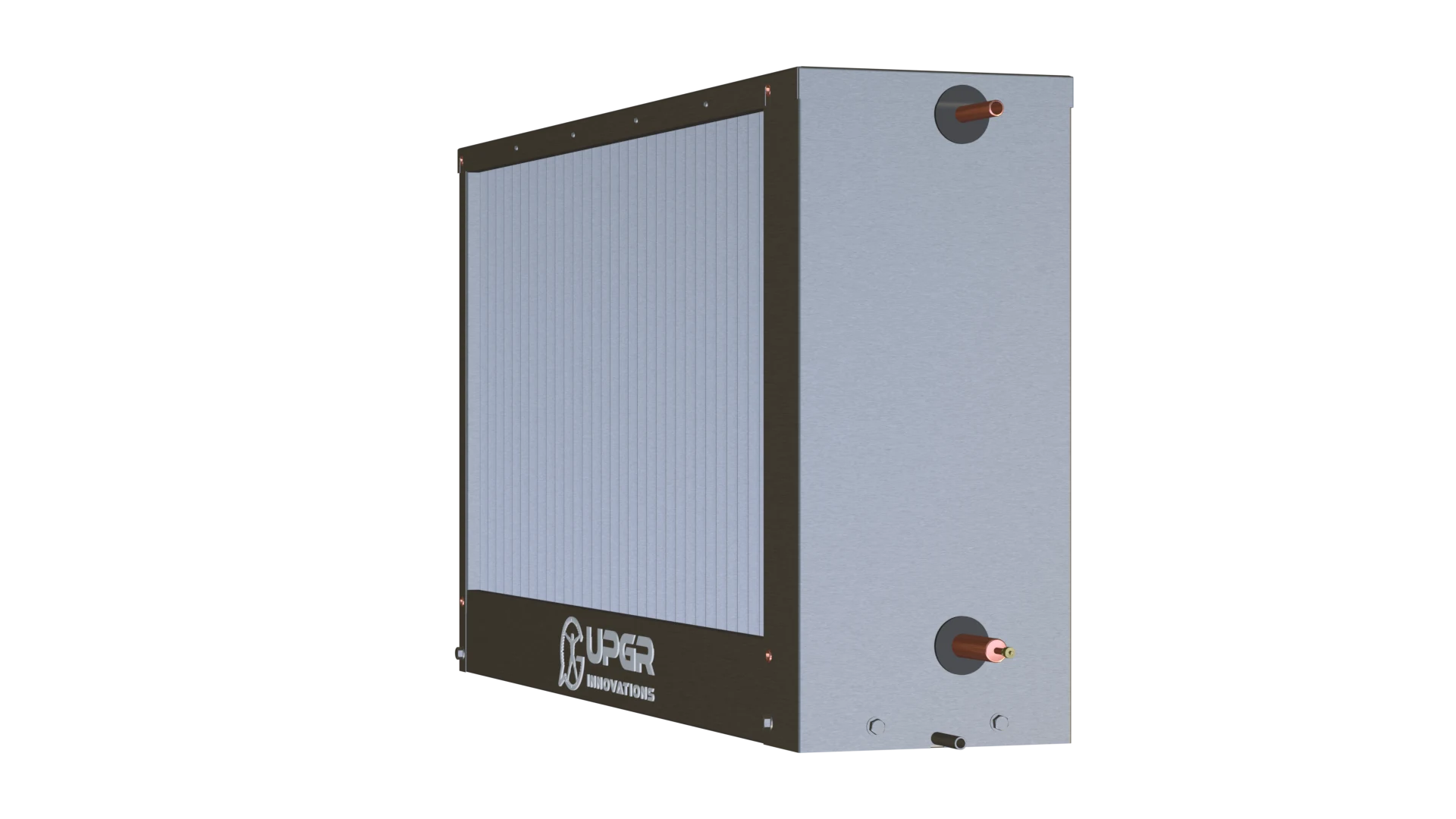
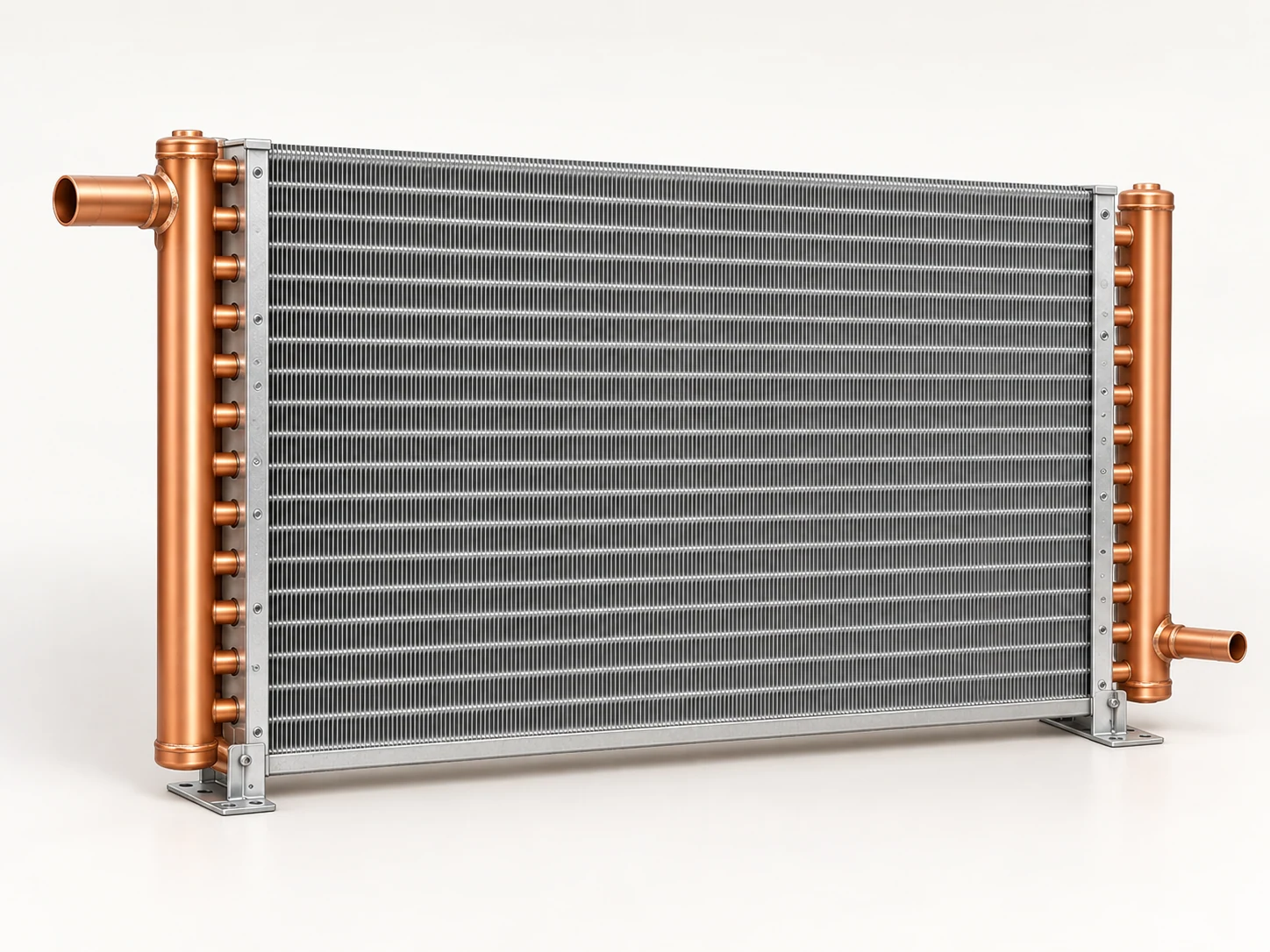
DX evaporatorOwned UPGR archive 3D visualization of КФО 100-50. The view shows the exterior of a refrigerant cooling coil; internal circuits, operating conditions and the ordered configuration are defined during selection.Air-cooled condenserGenerated concept of one air-condenser coil section. Headers and geometry are illustrative; a complete condensing unit and its refrigerant circuit are not shown.
01
The refrigerant designation is an input
Copy the designation from the equipment nameplate or current documentation. If the nameplate, service record and new specification disagree, retain all versions and identify which is confirmed. Do not infer the refrigerant from connection size or the coil's appearance.
IN PRACTICE
Two roles in a refrigerant system
Two functions are compared: cooling air with an evaporator and rejecting heat with a condenser. The images do not define a selected refrigerant circuit.
01
KFO refrigerant cooling coil
The owned archive render shows a duct coil casing. Its internal refrigerant distribution circuit is not visible.
02
Condenser concept
The second image represents one coil section, not a complete outdoor unit.
03
Selection inputs
Specify the refrigerant, duty, operating conditions and required circuit arrangement.
The first image is an owned UPGR KFO archive render; the second is a generated condenser-coil concept. Pressure rating, circuits and refrigerant compatibility require separate confirmation.
02
The coil's role in the refrigeration cycle
An evaporator absorbs heat, while a condenser rejects it to its surroundings. Identify the function of the coil and include the equipment diagram. If several operating modes are intended, list them separately; selection must confirm the coil's suitability for each.
03
Circuits and connections for replacement
Record the documented number of independent circuits, connection positions and distributor identification where present. Do not derive circuit count from the visible return bends. For replacement, provide photographs of both sides and identify each connection on the existing equipment diagram.
04
Operating duty and refrigerant changes
Provide the equipment operating point, available temperatures or pressures and air conditions. Add the design superheat or subcooling information relevant to the evaporator or condenser where known. A refrigerant change requires a separate review of coil and equipment suitability; matching dimensions do not establish an acceptable substitution.
REVIEW THE RESULT
Checks for the refrigerant circuit
Designation and role agreed
Match refrigerant and coil role to confirmed documentation, and flag discrepancies between the nameplate and new specification.
Connections identified
Map connections and independent circuits to the diagram; do not count circuits from visible return bends alone.
Replacement scope reviewed
Distinguish a like-for-like fluid replacement from a refrigerant change; dimensions alone do not establish suitability.
SELECTION INPUTS
Inputs to prepare
Exact refrigerant designation and its source.
Evaporator, condenser or documented multiple operating modes.
Equipment model, circuit diagram and original operating point.
Air conditions, required duty and available refrigerant parameters.
Documented circuits, distributors and connection functions.
For replacement: dimensions, nameplate and photographs of both sides.
What do you need to do?
Select a new coil
Define operating conditions first. The input checklist above describes the data needed for this application. The enquiry form adapts to the selected duty; it does not calculate a coil rating.
Add the equipment nameplate, photographs, overall and finned dimensions, airflow direction, connections and access constraints. Matching the envelope alone does not confirm performance or compatibility.
Separate fixed interfaces from dimensions open to change. Attach the current drawing revision, duty points, material requirements, quantity and acceptance criteria. Manufacturing feasibility is confirmed for the specific specification.
Final performance, materials and compatibility require a project-specific selection and an approved drawing.
Questions about this application
Are all refrigerant coils DX evaporators?
No. The name identifies the fluid family, not the cycle role. Use the equipment documentation to identify the function: an evaporator and a condenser perform different duties.
Can a replacement be ordered from the refrigerant name alone?
The designation is only one input. Duty, construction, circuits, connections and installation dimensions are also needed; identify missing information explicitly.
Does changing refrigerant only involve replacing the coil?
That conclusion requires an equipment review. Confirm the suitability of the coil and other components for the new specification; this page does not define a universal conversion method.