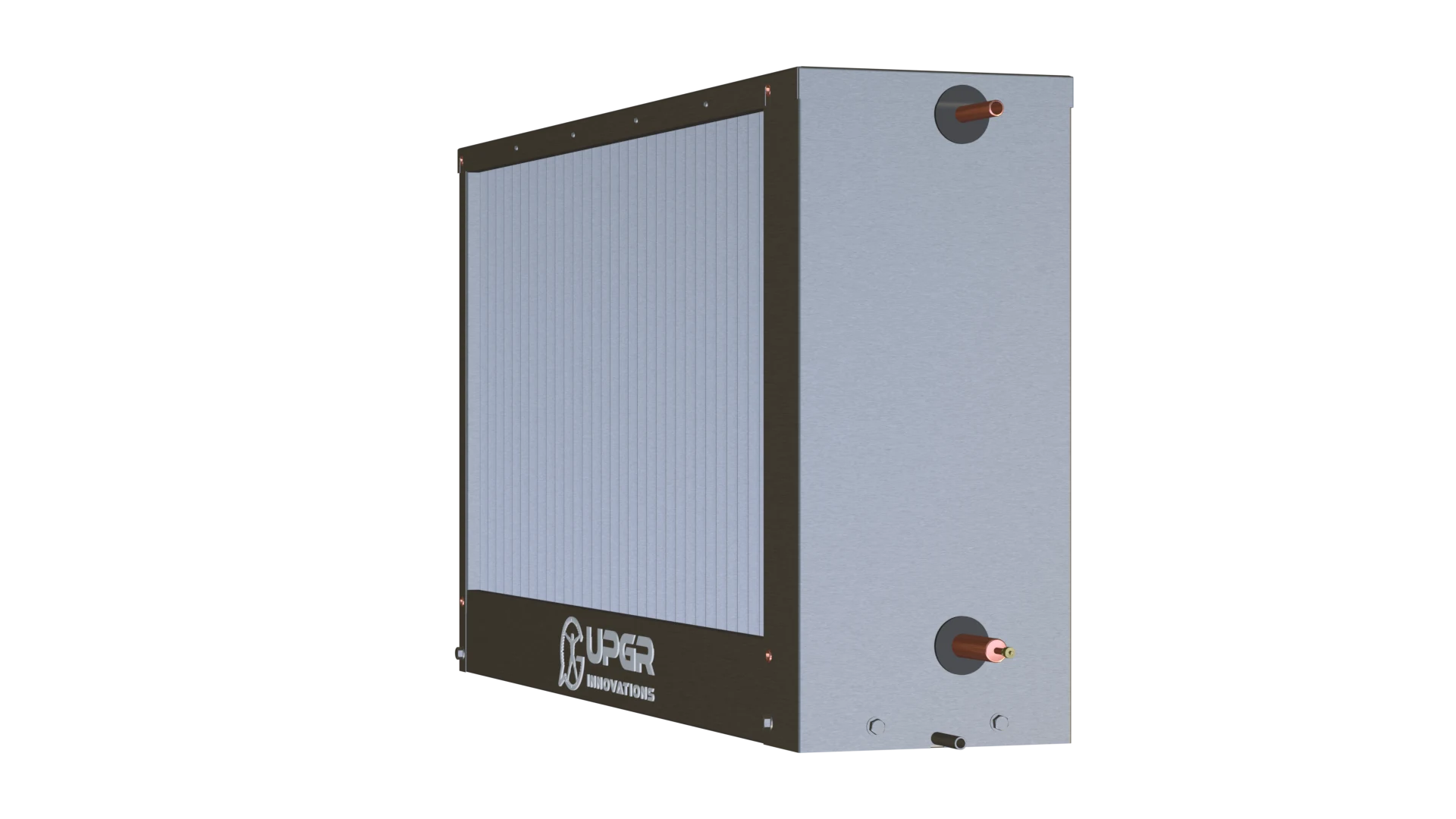
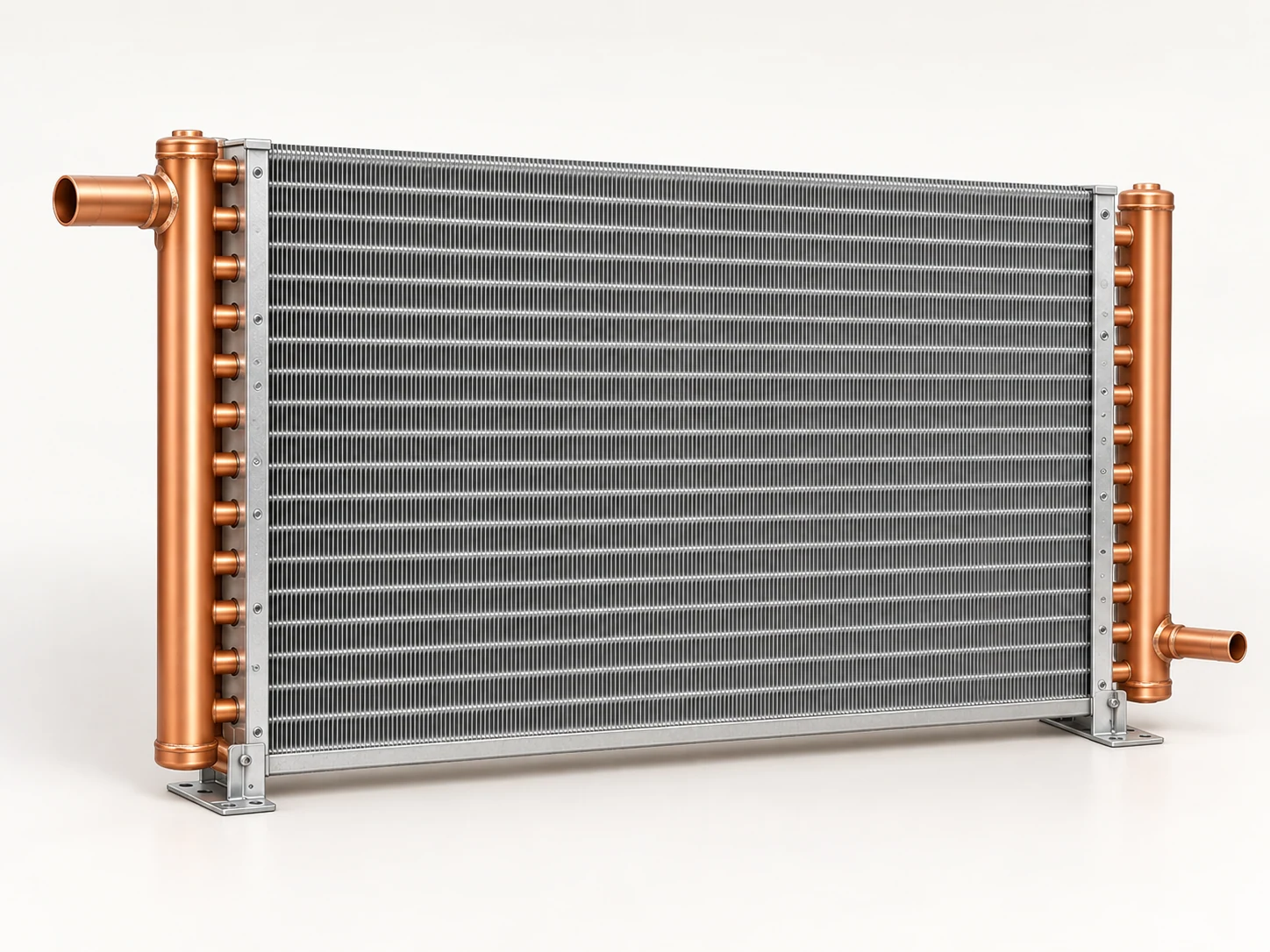
DX evaporatorOwned UPGR archive 3D visualization of КФО 100-50. The view shows the exterior of a refrigerant cooling coil; internal circuits, operating conditions and the ordered configuration are defined during selection.Air-cooled condenserGenerated concept of one air-condenser coil section. Headers and geometry are illustrative; a complete condensing unit and its refrigerant circuit are not shown.
01
First identify the component being described
A view of the finned surface helps locate the component, but does not establish its materials or internal circuit. Start with the equipment model, nameplate and photographs showing the heat exchanger and connections. Keep an unknown technology marked as unknown until checked. The fact that a component belongs to an air conditioner does not establish Cu-Al construction.
02
Function depends on equipment and operating mode
An evaporator and a condenser perform different roles in a refrigeration circuit. Indoor and outdoor describe location, but do not replace the operating diagram; for a heat pump, state the operating mode being considered. Preserve the documented function in the enquiry, or show the complete assembly in its equipment context if the function is unknown.
IN PRACTICE
Identify the function, not just the location
Indoor or outdoor location alone is not a complete description of a heat exchanger.
01
Cooling mode
Identify the section that absorbs heat and the section that rejects it.
02
Reversible operation
A heat pump can change the functions of its coils with operating mode.
03
Equipment identity
Nameplate, model, circuit diagram and photographs.
The archive KFO duct cooling coil and condenser-coil concept illustrate different functions. They are not a matched indoor and outdoor air-conditioning set.
03
From identification to replacement assessment
Once the technology is identified, compare installation dimensions, connections, circuits and the required duty. Similar dimensions or a model name do not establish interchangeability. Replacing an individual coil also differs from supplying a complete unit. Documentation supports an assessable enquiry without claiming OEM compatibility from a photograph alone.
REVIEW THE RESULT
From a photograph to a replacement review
Identify the component
Link photographs to the complete equipment model, unit identity and coil nameplate where available. The first useful result is identification of the heat-exchanger technology and function, or a list of missing identification data.
Clarify the operating mode
For reversible equipment, identify the required modes and provide the available circuit diagram. Indoor and outdoor describe location; the replacement task should identify the coil function in each specified mode.
Confirm the proposed replacement
Compare the proposed construction with the original for fit, connections, circuits and operating conditions. The review should identify confirmed matches and remaining differences; a similar photograph does not establish compatibility.
SELECTION INPUTS
Inputs to prepare
Equipment manufacturer and full model from the nameplate.
Indoor or outdoor unit; air conditioning or heat pump operating mode.
Coil function and refrigerant where supported by documentation.
Overview photographs of the coil, connections and installation.
A drawing or measurements with directions and reference points identified.
Required scope: identification, coil replacement or another assembly.
What do you need to do?
Select a new coil
Define operating conditions first. The input checklist above describes the data needed for this application. The enquiry form adapts to the selected duty; it does not calculate a coil rating.
Add the equipment nameplate, photographs, overall and finned dimensions, airflow direction, connections and access constraints. Matching the envelope alone does not confirm performance or compatibility.
Separate fixed interfaces from dimensions open to change. Attach the current drawing revision, duty points, material requirements, quantity and acceptance criteria. Manufacturing feasibility is confirmed for the specific specification.
Final performance, materials and compatibility require a project-specific selection and an approved drawing.
Questions about this application
Is an air conditioner “radiator” always copper-aluminium?
No. The informal name does not determine the technology. Establish materials and construction for the specific product from its documentation; do not guess when information is missing.
Can an exact equivalent be identified from a photograph?
A photograph can start identification and highlight questions. Confirming a replacement requires related model, geometry, connection and operating information; appearance alone does not provide that evidence.
What if the nameplate is unreadable?
Start with an equipment overview, any available markings and photographs of the connections. Mark unknown fields explicitly so later assessment can distinguish source facts from assumptions.