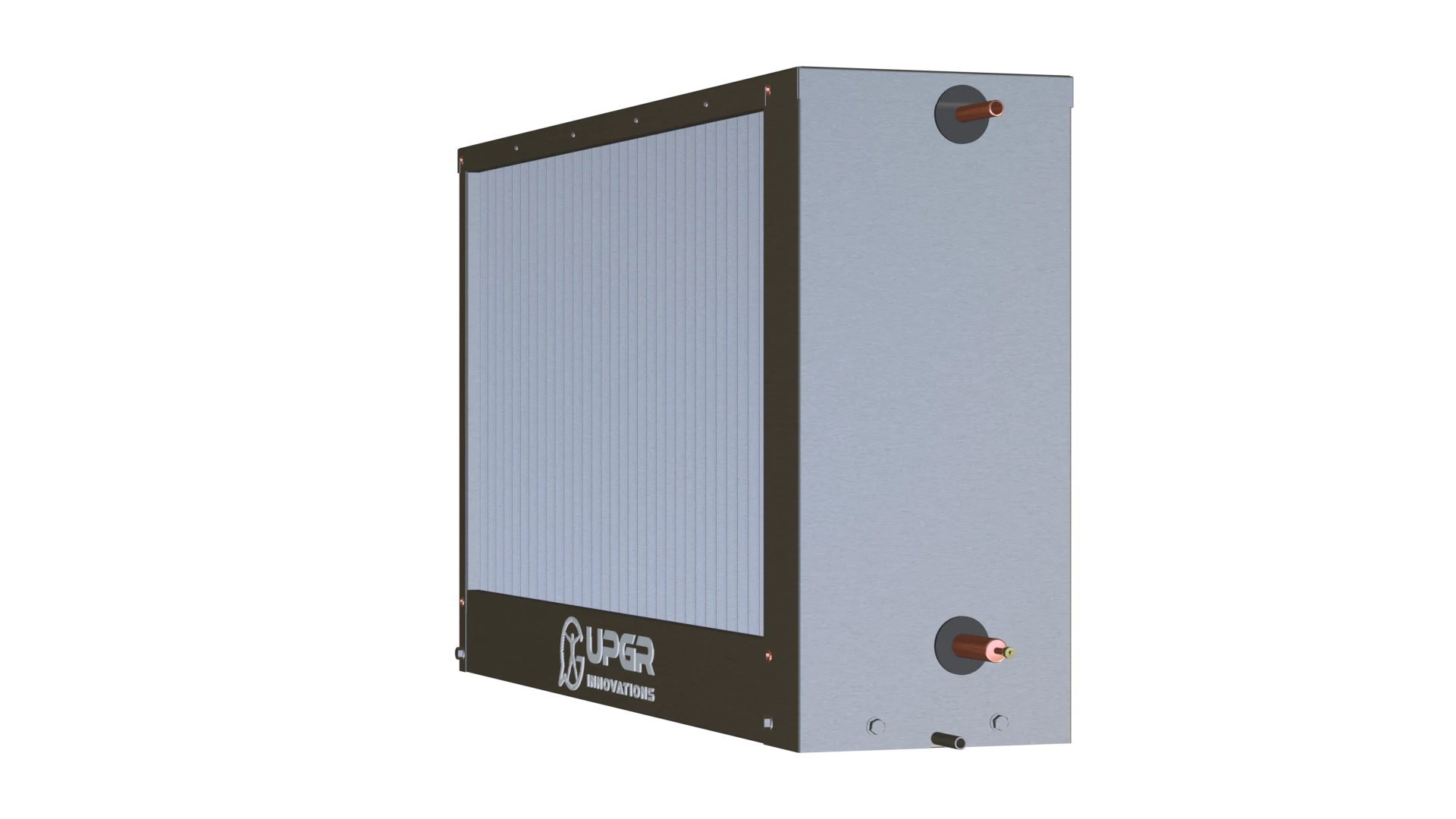
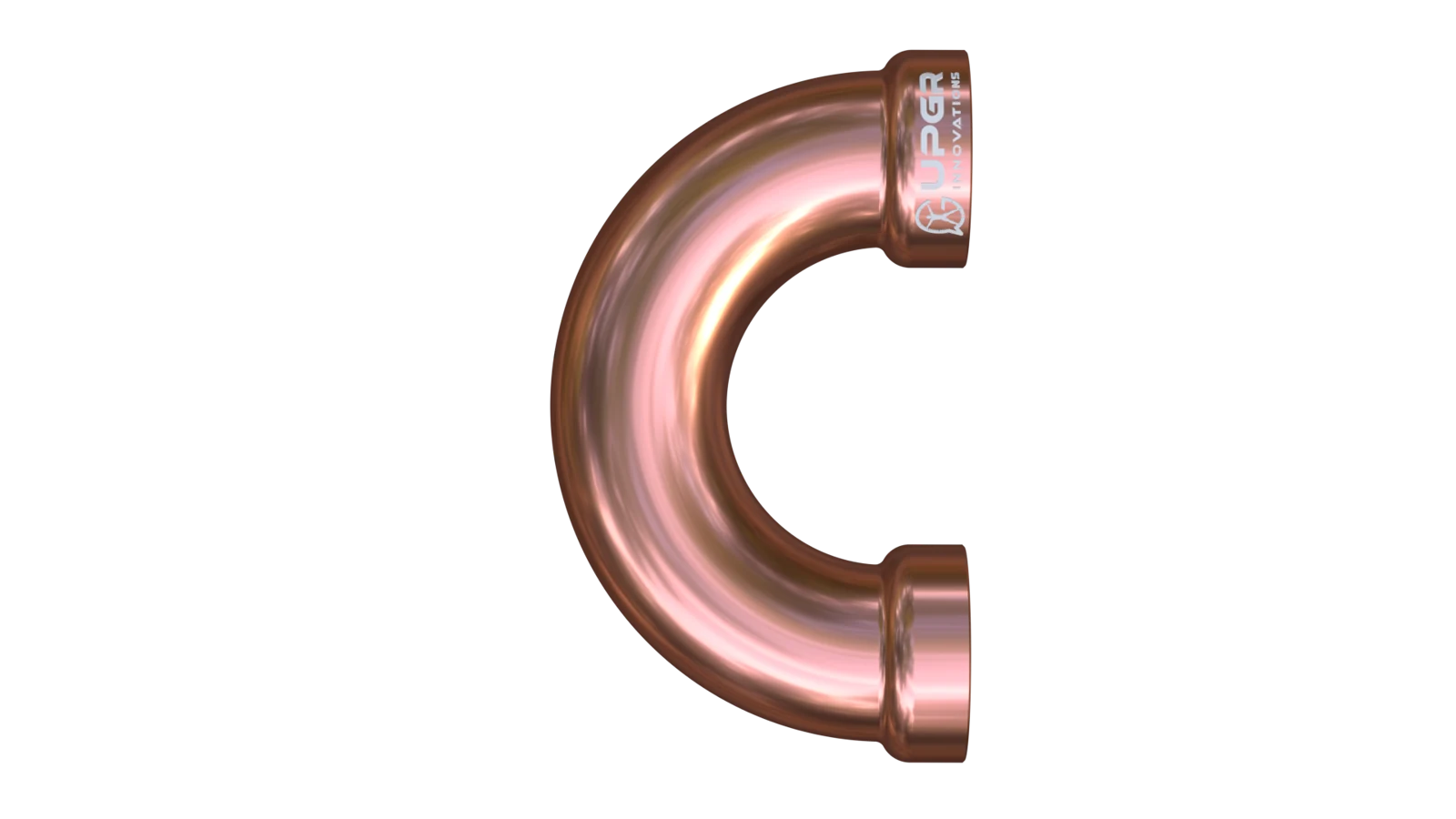
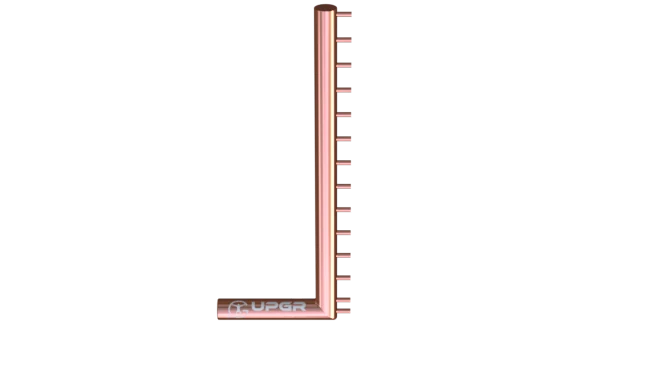
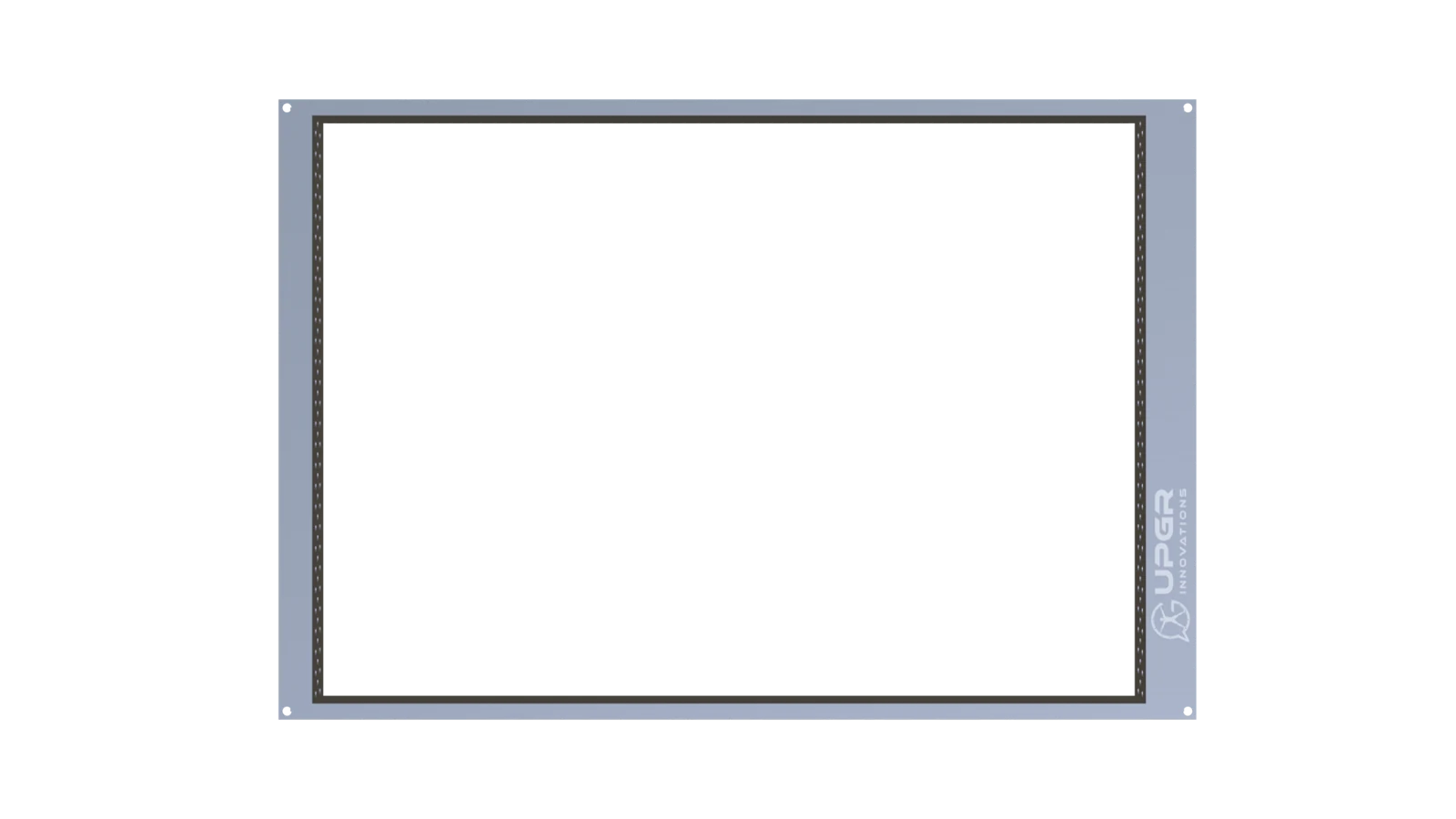
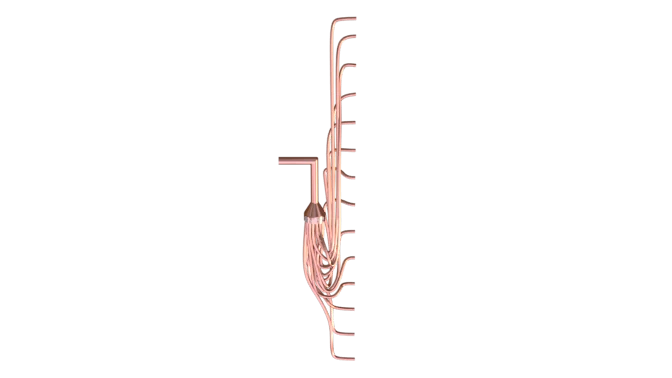
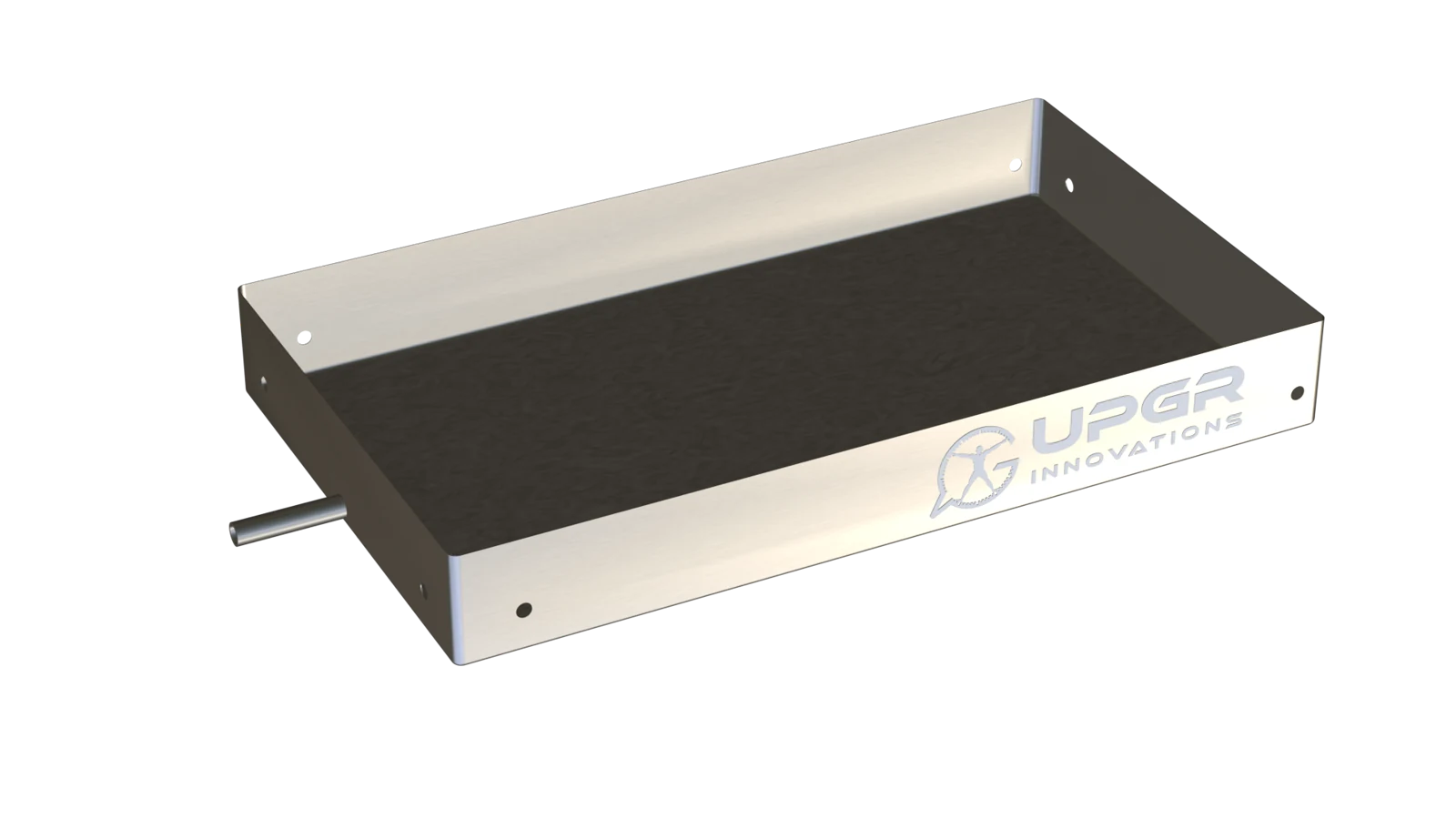
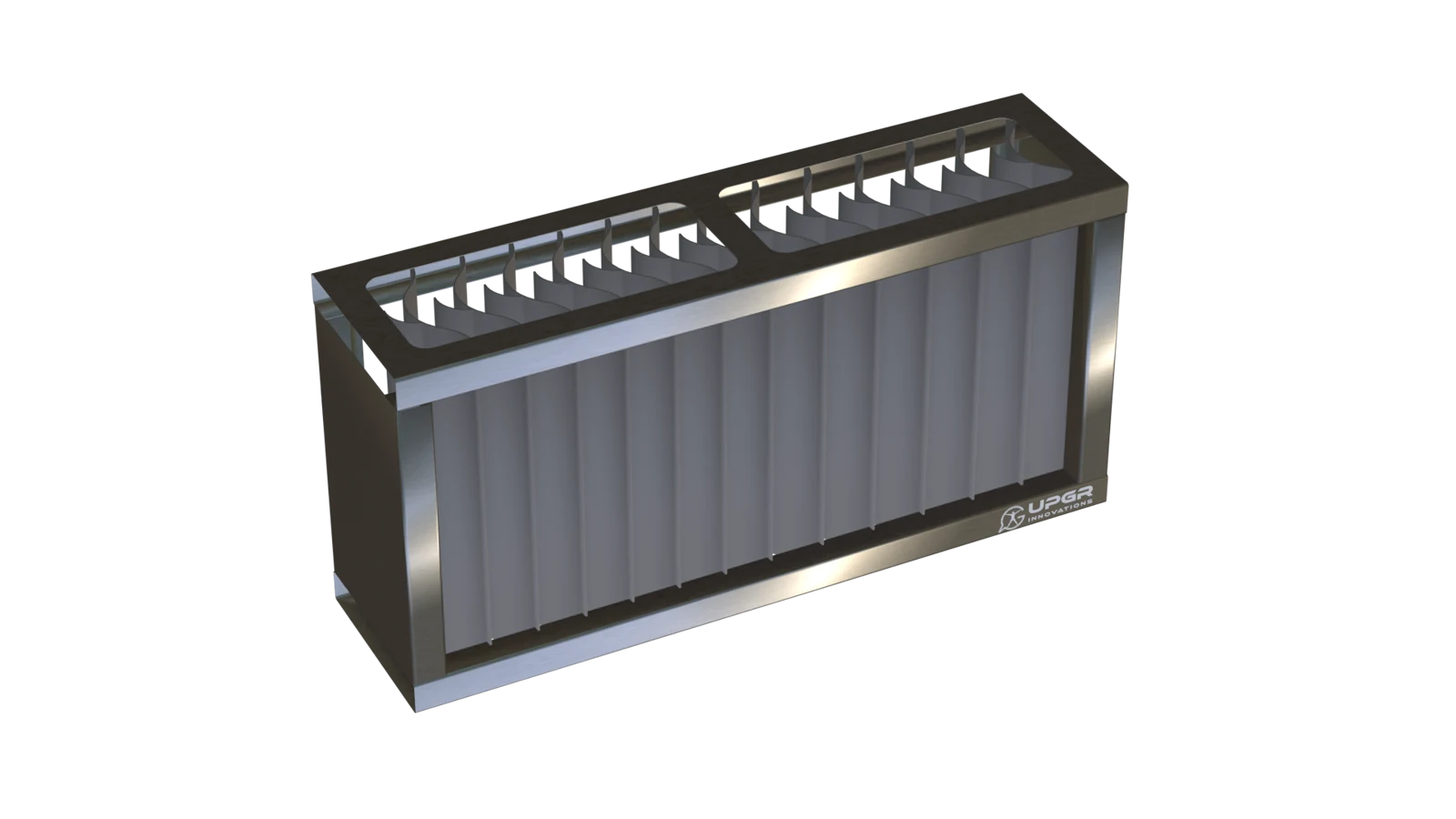
Owned UPGR archive 3D visualization of КФО 100-50. The view shows the exterior of a refrigerant cooling coil; internal circuits, operating conditions and the ordered configuration are defined during selection.
Inside the heat exchanger
In a DX evaporator, refrigerant absorbs heat as it evaporates inside the tubes. Circuit distribution differs from a water coil; wet operation also needs condensate drainage.
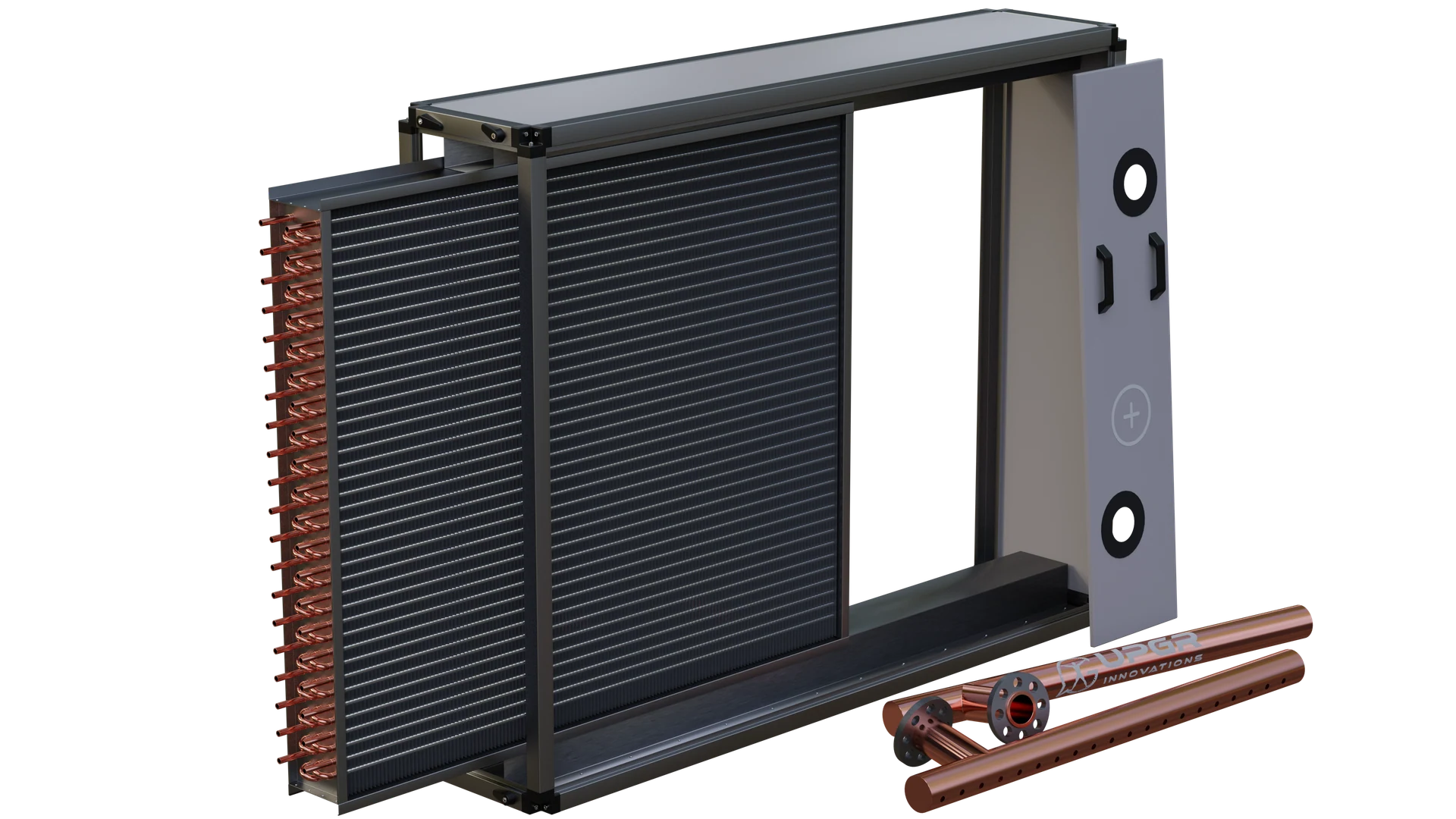
Read the following parts as a typical CuAl coil anatomy. Actual circuiting and accessories vary with the equipment and duty.
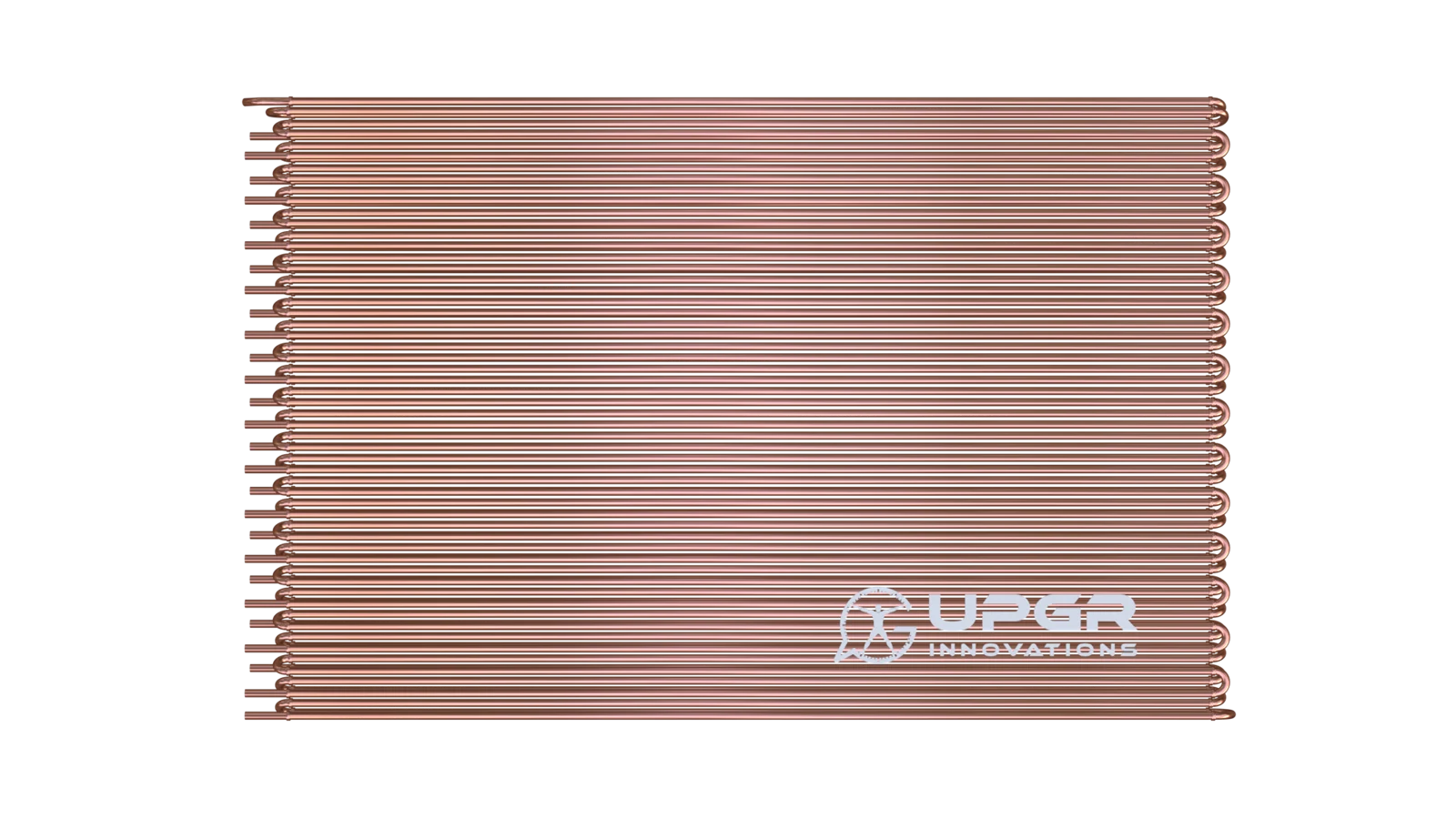
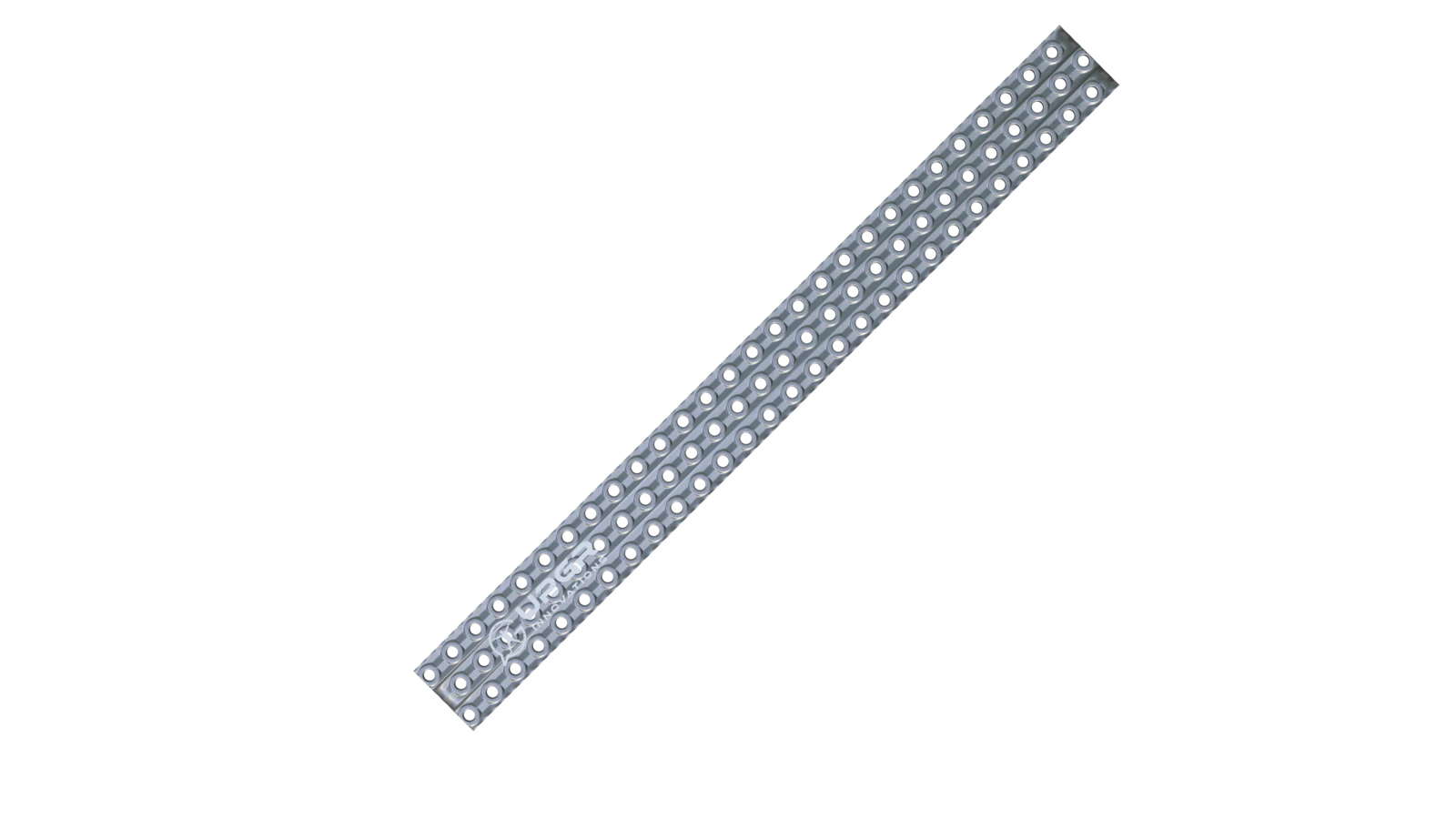
Open a larger image: Exploded view of a finned-tube section. Individual parts below illustrate their function; their dimensions and arrangement vary between coil designs.
A downstream separator for droplets carried by the airflow.
Intercepts droplets and lets collected water drain.
Conditional on carryover risk and equipment design; not every cooling coil has one.
What to inspect
Contamination, damage or water carryover.
Condition signs help identify what needs inspection; they do not identify the fault by themselves. Service methods and intervals follow the equipment manual.
01
Evaporators and air-cooled condensers
An evaporator absorbs heat from the air being cooled; a condenser rejects heat to an airstream. Both can look like finned coils, so an overview photograph does not establish their function. State the equipment, the coil's role in the circuit and the duty. The general term refrigerant coil does not distinguish these tasks.
02
Refrigerant and circuit arrangement
The refrigerant designation is an input, not a universal approval for a coil. Operating conditions, circuit layout, distribution and connections must be considered for the specific construction. A distributor or similar-looking tubes do not prove compatibility. For an existing product, use its specification, circuit drawing and manufacturer information as primary evidence.
IN PRACTICE
One coil, two sets of operating conditions
An evaporator takes heat from the air into the refrigerant. Both sides are needed for selection.
01
Air side
Flow, inlet temperature and humidity, required outlet condition.
02
Heat exchange
Coil surface, airflow resistance and moisture removal.
03
Refrigerant side
Refrigerant, evaporation conditions and circuit requirements.
The archive KFO render shows the casing and external connections. The distributor and internal circuits are hidden; their arrangement is defined by the circuit drawing and manufacturer selection.
03
Air, moisture and installation
Assess air temperature and humidity together with airflow: cooling may involve moisture condensation. Check the permitted air-side pressure drop and installation constraints. For replacement, record the connections and the exact assembly being replaced. Documenting these inputs is not a completed refrigeration system calculation.
REVIEW THE RESULT
What to agree for a DX evaporator
Refrigerant and duty
Record the exact refrigerant designation and documented evaporation conditions; identify unknown values separately. The selection result should link this duty to airflow, air temperature and humidity.
Circuits and distribution
Provide the available circuit diagram, connections and distributor information. Replacement requires an agreed arrangement for the specific construction; circuit count and the appearance of the tubes do not describe it completely.
Fit and assembly scope
Agree the envelope, airflow direction and connection positions on the drawing. Define separately which refrigerant-circuit and condensate-handling components belong to the coil supply.
Standard sizes, drawings and model cards
Compare the recovered series by nominal opening, frame and casing depth. Each model has its own drawing and render; final suitability depends on the operating duty and connections.
Equipment type, model and the coil's function in the circuit.
The exact refrigerant designation from the documentation.
Entering airflow, air temperature and humidity.
Required air-side duty and evaporating conditions if known.
Installation dimensions, airflow direction and allowable pressure drop.
Circuit drawing, connections, distributor details and nameplate, where available.
What do you need to do?
Select a new coil
Define operating conditions first. The input checklist above describes the data needed for this application. The enquiry form adapts to the selected duty; it does not calculate a coil rating.
Add the equipment nameplate, photographs, overall and finned dimensions, airflow direction, connections and access constraints. Matching the envelope alone does not confirm performance or compatibility.
Separate fixed interfaces from dimensions open to change. Attach the current drawing revision, duty points, material requirements, quantity and acceptance criteria. Manufacturing feasibility is confirmed for the specific specification.
Final performance, materials and compatibility require a project-specific selection and an approved drawing.
Questions about this application
Are DX and water cooling coils interchangeable?
They use different working media and system arrangements. Similar external geometry does not establish interchangeability; first identify the circuit and the engineering duty.
Is it enough to specify only “refrigerant”?
That may be enough to describe the initial enquiry, but checking a specific construction requires the exact documented designation. If it is unknown, mark it as unknown and provide the equipment nameplate.
Is the circuit count enough to specify an equivalent coil?
No. A circuit count does not describe the complete routing, distribution, connections or operating duty. Related information is needed to assess the specific construction.