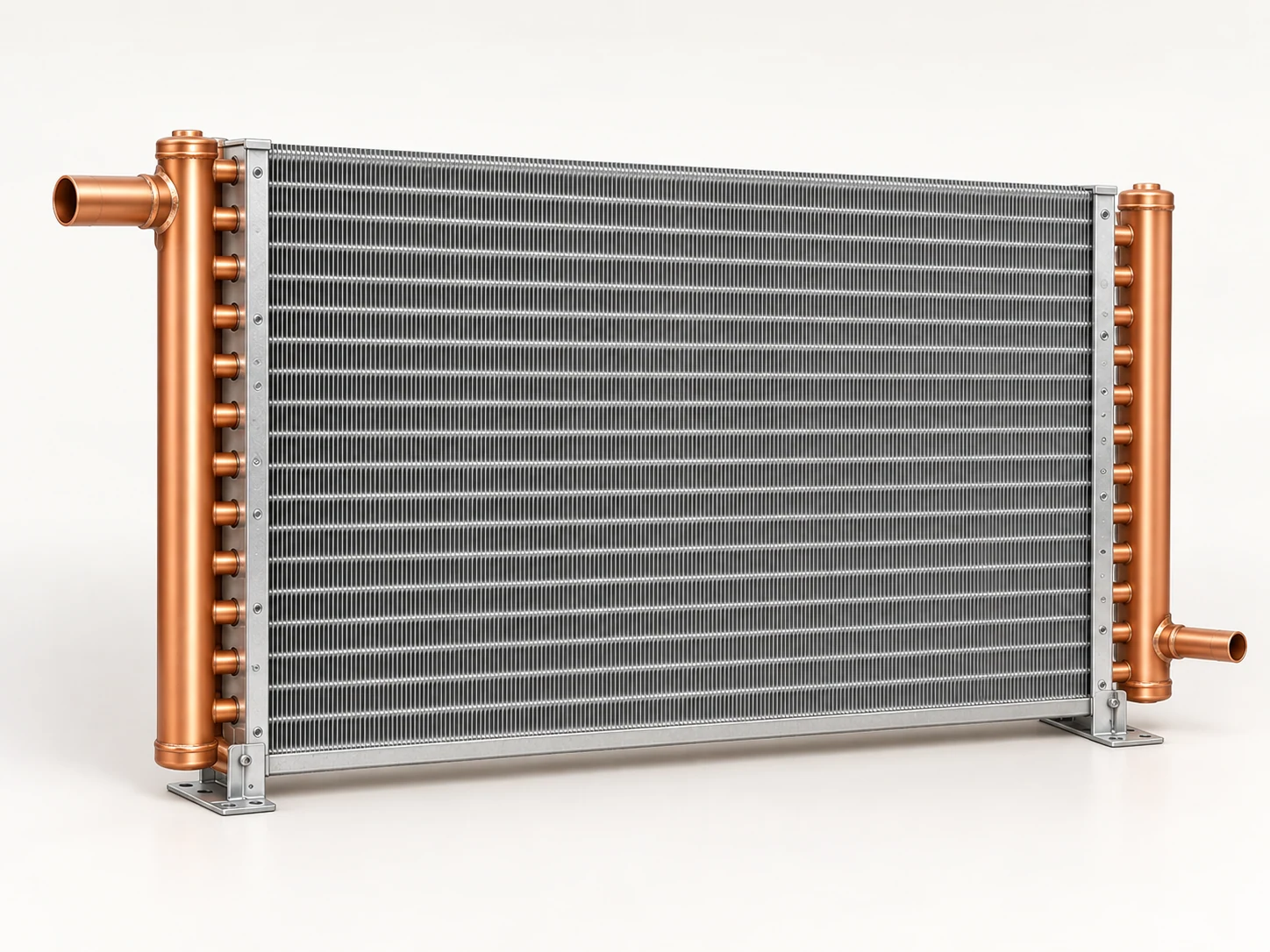
Generated concept of one air-condenser coil section. Headers and geometry are illustrative; a complete condensing unit and its refrigerant circuit are not shown.
01
Define the coil or assembly required
A finned coil and a complete air-cooled condenser have different supply boundaries. State whether the existing fans, casing and connections will remain, or whether new equipment is being considered. This distinction relates the coil to the actual airflow arrangement and avoids assuming components that have not been included in the scope.
IN PRACTICE
Define the scope before comparing condensers
A coil, an air-cooled assembly and a condensing unit are different scopes of supply.
01
Finned coil
Tubes, fins, connections and frame.
02
Air-cooled assembly
A coil plus a defined fan and casing arrangement.
03
Condensing unit
A refrigeration unit with additional equipment, including a compressor.
The illustration shows one heat-exchanger coil section, not a complete fan-cooled unit. The final circuit and equipment scope are confirmed during selection.
02
Condensing duty and air conditions
The refrigerant and condensing conditions define one side of the duty; air temperature and airflow define the other. Dimensions or fan count do not replace these inputs. If only a refrigeration equipment rating is available, retain its original description and conditions rather than relabelling it as the required condenser heat rejection without assessment.
03
Construction and installation context
Selection must account for airflow direction, coil position and connection layout. Materials and coatings are considered for the actual operating environment rather than treated as universal properties of every Cu-Al product. Replacement requires information on the existing circuit and mounting arrangement; a similar shape does not establish the same operating requirements.
REVIEW THE RESULT
What to compare for air-cooled condensers
The same supply scope
First align proposals to the same object: a coil, a fan-equipped assembly or a complete unit. Each option should list the casing, fans and other included components so that the scopes can be compared.
The same operating conditions
Link the heat-rejection duty to the refrigerant, condensing conditions and entering air temperature. Identify any unknown airflow; the chiller capacity alone is not a complete condenser specification.
An agreed arrangement
Clarify airflow direction, available space and retained equipment. The expected result is a selection sheet for the stated duty and a drawing of the selected assembly, both referring to the same configuration.
SELECTION INPUTS
Inputs to prepare
Coil or complete unit; which existing components will remain.
Refrigerant and documented condensing conditions.
Entering air temperature and airflow if known.
Heat rejection duty with its operating conditions and source.
Installation envelope, connections and airflow direction.
Model, drawing, nameplate and operating environment for an existing assembly.
What do you need to do?
Select a new coil
Define operating conditions first. The input checklist above describes the data needed for this application. The enquiry form adapts to the selected duty; it does not calculate a coil rating.
Add the equipment nameplate, photographs, overall and finned dimensions, airflow direction, connections and access constraints. Matching the envelope alone does not confirm performance or compatibility.
Separate fixed interfaces from dimensions open to change. Attach the current drawing revision, duty points, material requirements, quantity and acceptance criteria. Manufacturing feasibility is confirmed for the specific specification.
Final performance, materials and compatibility require a project-specific selection and an approved drawing.
Questions about this application
Is an air-cooled condenser the same as a dry cooler?
No. In the condenser described here, refrigerant condenses while rejecting heat to air. A dry cooler has a liquid cooling duty. A similar finned appearance does not make those operating conditions equivalent.
Are fans included with the coil?
That depends on the specific supply scope. This page describes the heat exchanger; fans, casing and controls must be confirmed separately.
Can a condenser be selected from a chiller capacity alone?
That rating is useful as part of the source documentation, but it does not describe the complete condenser duty. Related refrigerant, condensing and air-side conditions are needed, with the original rating interpreted correctly.