A packaged rooftop air conditioner contains different heat-exchange components. Mark the required coil on a photograph and retain the unit and refrigerant-circuit identification.
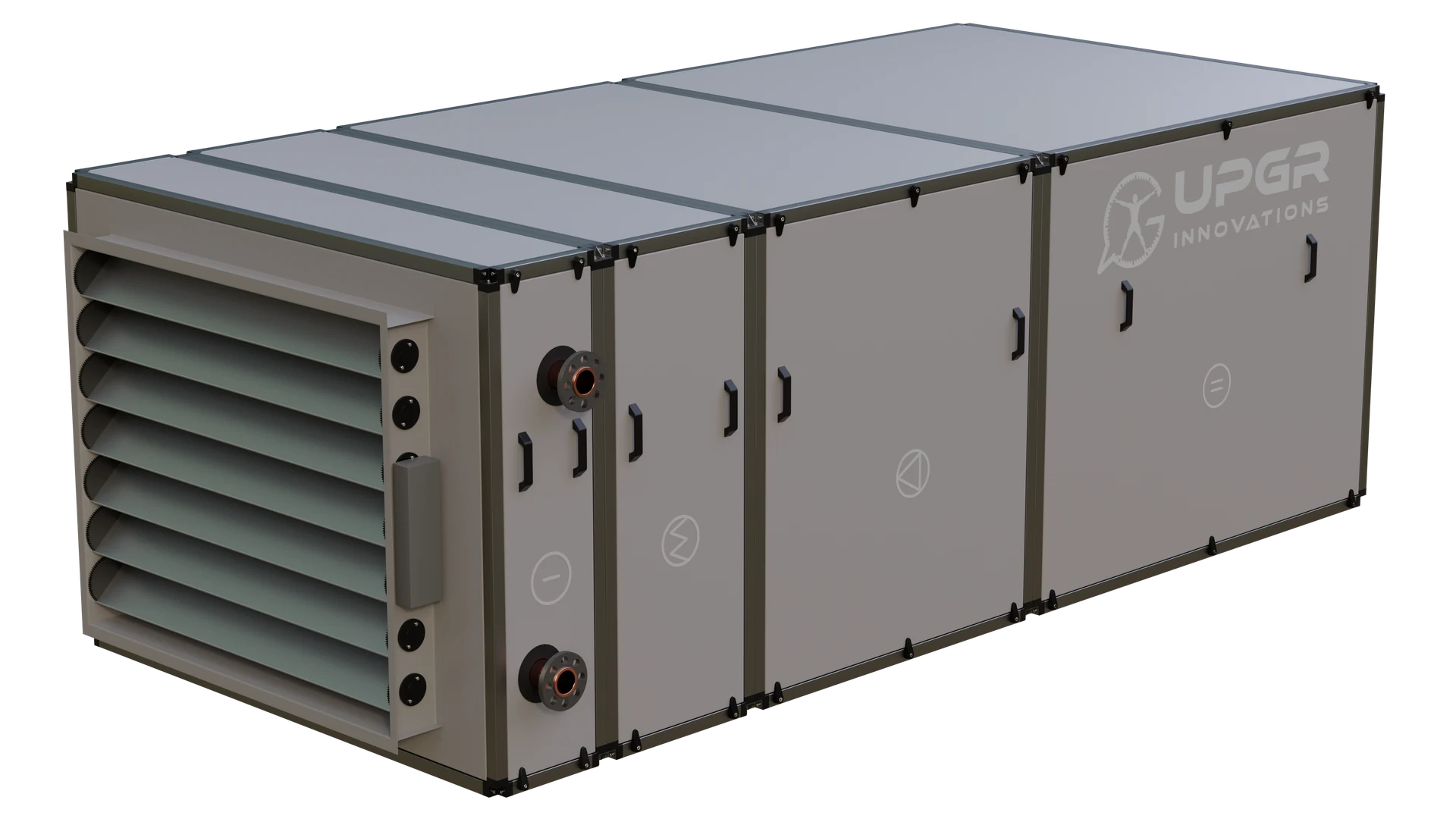
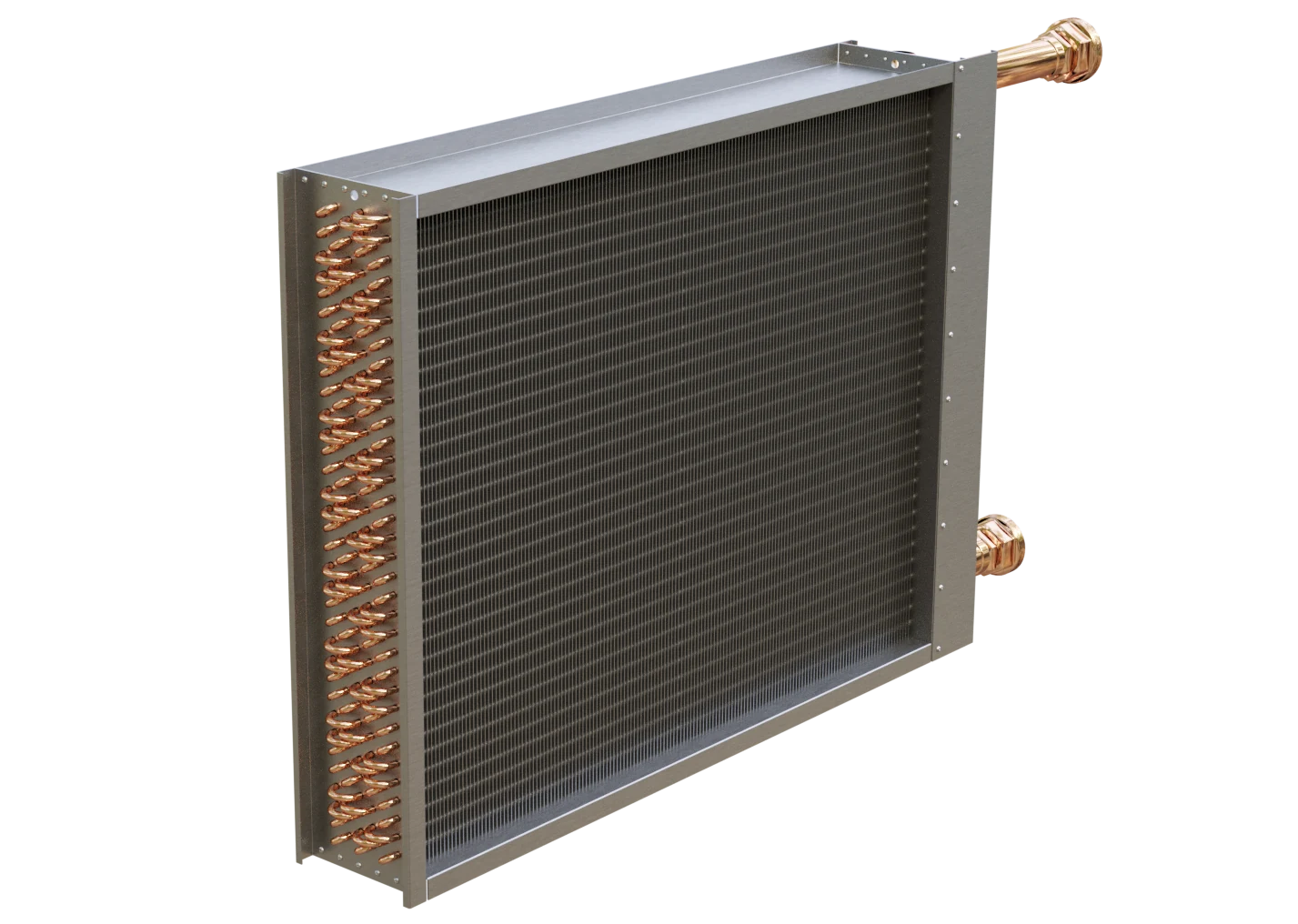
Sectional ventilation unitUPGR archive 3D visualization of a sectional ventilation unit. The closed casing does not establish the internal section order or airflow direction.Liquid coil — finned faceUPGR archive 3D visualization of a liquid coil. The view shows the finned surface and return bends; dimensions, fluid and internal circuits are specified for the project.
01
Evaporator and condenser duties are distinct
During cooling, one coil conditions the air supplied to the building while another rejects heat outdoors. Select replacements for those duties separately. If the rooftop unit operates as a heat pump, check its circuit and all required operating modes rather than assigning a permanent function from the coil's location alone.
IN PRACTICE
The coil within the equipment
General ventilation-unit and liquid-coil views explain the component level while the rooftop model remains to be identified.
01
Identify the rooftop
Send the unit model and the section to be replaced or specified.
02
Locate the coil
Record its frame, air passage, connection side and access route.
03
Confirm the interfaces
Use the equipment drawing and measurements to establish fit.
These generic archive views cannot establish rooftop dimensions, weather protection or a supplied package.
02
Model and circuit identity matter more than appearance
Record the complete model, serial number and the circuit being replaced. Check the refrigerant, circuit arrangement, connections and original coil construction. The term rooftop does not establish a Cu-Al design; visual similarity alone does not justify substituting a copper-aluminium coil for another technology.
03
Air conditions and condensate drainage
The air-treatment coil needs airflow, entering temperature and humidity, and the required result. The outdoor coil needs ambient conditions and its airflow arrangement. For a cooling coil, check the drain-pan and condensate-outlet positions; matching coil dimensions does not establish correct integration with the complete air path.
04
Replacing a component within the unit
Compare the frame, coil depth, fixings and connection positions with the available opening. Show service panels and the removal route. An image of an isolated coil represents that component only; compressors, fans, controls and the rooftop casing remain separate parts of the scope.
REVIEW THE RESULT
What to check when replacing a rooftop coil
Exact model and circuit
Link the proposal to the model, serial number, coil identity and circuit. Evaporator or condenser duty must match the specified operating mode; do not accept materials or circuiting from visual similarity.
Consistent air and refrigerant conditions
Check airflow, air state, refrigerant and refrigeration inputs for this specific coil. Identify the checked modes separately for a reversible unit; total rooftop capacity does not replace a coil selection.
Fit within the existing casing
Verify the frame, depth, fixings, connections and service opening. For a cooling coil, also check its interface with the drain pan and drainage. An isolated-coil image does not validate the complete unit.
SELECTION INPUTS
Inputs to prepare
Complete rooftop nameplate, model, serial number and a photograph marking the required coil.
Coil function in the specified mode; circuit number where identified.
Refrigerant, documented operating conditions and original coil data.
Conditioned-air flow and state, or the outdoor coil's ambient and airflow conditions.
Frame and fin-pack dimensions, tube connections, headers and mounting positions.
Service access, drain pan and drainage for the cooling coil.
What do you need to do?
Select a new coil
Define operating conditions first. The input checklist above describes the data needed for this application. The enquiry form adapts to the selected duty; it does not calculate a coil rating.
Add the equipment nameplate, photographs, overall and finned dimensions, airflow direction, connections and access constraints. Matching the envelope alone does not confirm performance or compatibility.
Separate fixed interfaces from dimensions open to change. Attach the current drawing revision, duty points, material requirements, quantity and acceptance criteria. Manufacturing feasibility is confirmed for the specific specification.
Final performance, materials and compatibility require a project-specific selection and an approved drawing.
Questions about this application
Is a rooftop unit just a coil installed on a roof?
No. A packaged rooftop air conditioner comprises several components. A coil enquiry must identify the specific heat-exchange assembly within that unit.
Can an evaporator be selected from a condenser photograph?
No. A photograph helps identify the arrangement but cannot transfer one component's duty and circuit to another. Information must refer to the coil actually being replaced.
Is the rooftop unit's total cooling capacity sufficient?
It provides context but does not define an individual coil or the allocation among circuits. Operating conditions, component identity and connections are also required.