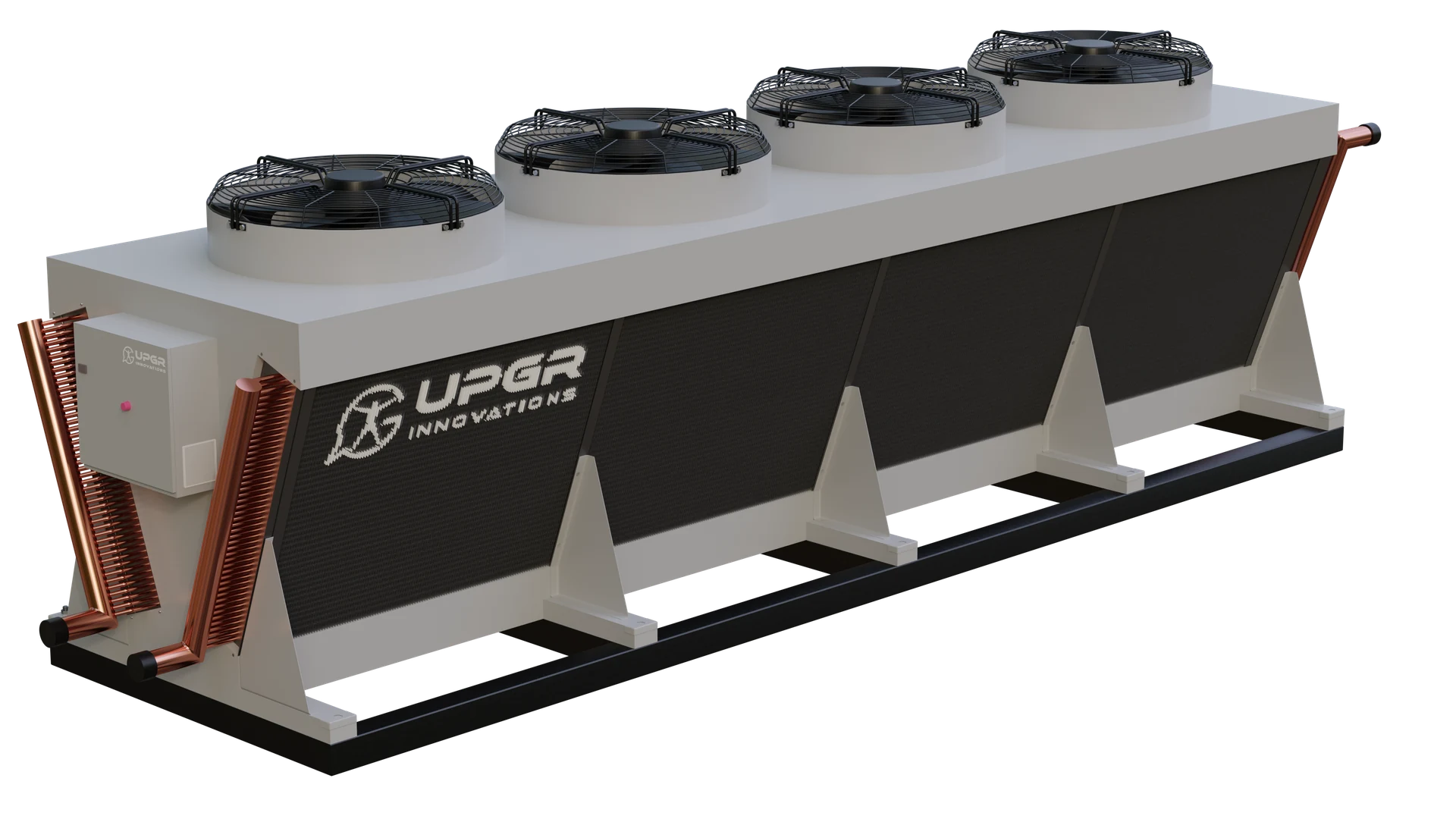
A chiller has several different heat-exchange components. First distinguish an air-side finned coil from the exchanger between refrigerant and water or glycol.
UPGR archive 3D visualization of a V-shaped air heat-exchanger block. The image does not establish a complete chiller, its compressors, evaporator or refrigerant circuit.
01
Air-cooled condenser
An air-cooled chiller rejects condenser heat to outdoor air. Its coil may use copper tubes and aluminium fins or another construction, including microchannel. Before selecting a replacement, establish the actual technology, number of sections and their relationship to the refrigeration circuits.
IN PRACTICE
An air heat-exchanger block
The archive image supports discussion of an air-side heat-exchanger assembly within the chiller topic.
01
Visible assembly
The V-shaped block, fans and cabinet can be seen in the render.
02
Equipment identity
Use the chiller model and documentation to identify the required coil.
03
Circuit and duty
Confirm whether the required section belongs to the refrigerant or liquid circuit and provide its operating data.
This visualization does not verify a complete chiller or the presence of compressors and an evaporator.
02
The liquid-cooling evaporator is a different exchanger
Water or glycol is cooled in the evaporator, separated from refrigerant by a heat-transfer wall. Examples include plate and shell-and-tube constructions. These are not Cu-Al air coils. Replacing them requires exchanger identification and both fluid conditions, not merely a photograph of the chiller's outdoor fins.
03
Condensing duty and free cooling
If the chiller has free cooling, a similar-looking finned section may belong to the liquid loop. Identify its connections and function from the documentation. A refrigerant condenser and a fluid coil need different inputs even when installed next to each other.
04
Coordinating the replacement with the chiller
Check the exact model, serial number, section identity and circuit diagram. An air coil additionally needs its airflow arrangement, frame and header access documented. Total chiller cooling capacity is not the individual condenser rating and does not describe installation fit.
REVIEW THE RESULT
What to check for a chiller heat exchanger
Construction and both media
Confirm whether the item is an air-cooled condenser, plate or shell-and-tube evaporator, or a liquid free-cooling coil. The chiller designation does not make Cu-Al construction applicable to every component.
Section and original circuit
Link the model, serial number and coil identity to the circuit diagram. Check medium, connections and required modes; matching outside dimensions does not validate refrigerant distribution.
Selection and installation conditions
Record outdoor temperature and airflow for an air coil, or fluid temperatures, flow and properties for a liquid exchanger. Check pressure drops, fit and service access for the identified component.
SELECTION INPUTS
Inputs to prepare
Chiller nameplate, model, serial number and the component marked on a diagram.
Exchanger type and its media: refrigerant, water, glycol and air.
Refrigeration-circuit identity, original arrangement and replacement-section data.
Fluid temperatures and flow rates; ambient conditions and airflow for an air coil.
Glycol concentration and allowable pressure drops where applicable.
Drawing, frame dimensions, connections, fixings and service access.
What do you need to do?
Select a new coil
Define operating conditions first. The input checklist above describes the data needed for this application. The enquiry form adapts to the selected duty; it does not calculate a coil rating.
Add the equipment nameplate, photographs, overall and finned dimensions, airflow direction, connections and access constraints. Matching the envelope alone does not confirm performance or compatibility.
Separate fixed interfaces from dimensions open to change. Attach the current drawing revision, duty points, material requirements, quantity and acceptance criteria. Manufacturing feasibility is confirmed for the specific specification.
Final performance, materials and compatibility require a project-specific selection and an approved drawing.
Questions about this application
Can every chiller heat exchanger be ordered as a Cu-Al coil?
No. First identify function and construction. A liquid-cooling evaporator and an air coil are different components, and even an outdoor condenser need not use copper-aluminium construction.
Can one coil be replaced using only the chiller capacity?
No. Its role within the unit, circuit, operating conditions and connections must be identified. Total capacity helps identification but does not define the individual section.
Is a free-cooling coil a condenser?
Not necessarily. A similar-looking section may cool water or glycol without condensing refrigerant. Check its function from the circuit diagram and working media.