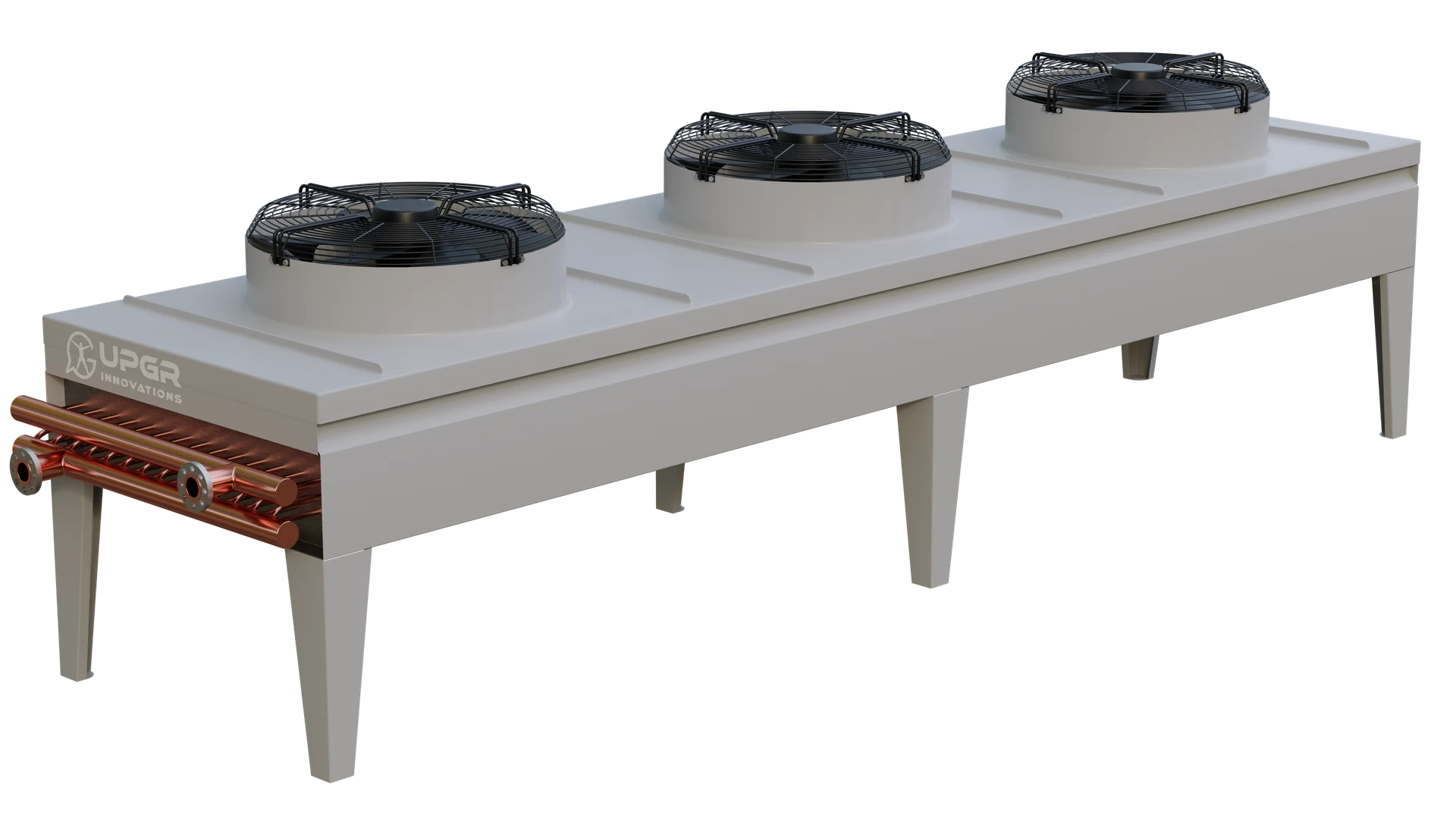
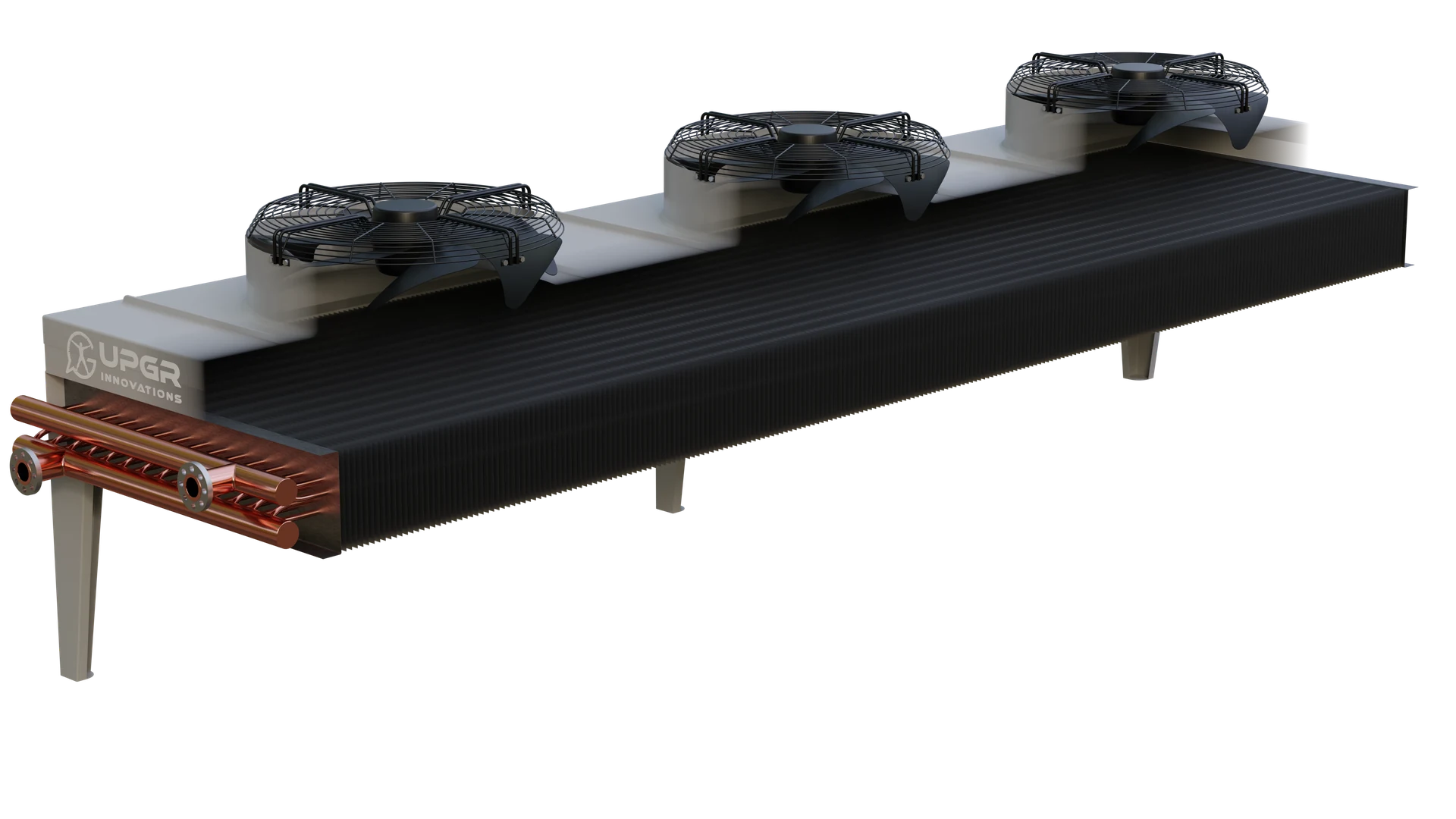
Dry cooler — assembledUPGR archive 3D visualization of a dry air cooler. This is a dry-cooler example; an evaporative cooling tower is not shown.Dry cooler — cutawayArchive presentation cutaway of a dry cooler. Parts of the casing are omitted to reveal the heat-exchange block; it is not an operating condition.
01
Three different arrangements
In a dry cooler, outdoor air cools the fluid through the tube walls and fins. In a closed-circuit evaporative tower, the process fluid remains inside the coil, while a separate spray-water circuit wets its outer surface; partial evaporation of that water helps reject heat. In an open tower, the cooling water contacts the air; an additional isolating heat exchanger may sit outside the tower. The equipment name does not identify the component to replace.
IN PRACTICE
A dry-cooler example, outside and inside
This archive pair shows a dry air cooler. It illustrates one equipment type within the broader heat-rejection topic.
01
Assembled view
Fans, casing, supports and fluid connections are visible together.
02
Presentation cutaway
The second view exposes the finned block by omitting portions of the casing.
03
Identify the equipment
State whether the enquiry concerns a dry cooler or an evaporative cooling tower.
The images do not depict an evaporative tower, spray circuit or fill. Capacity and operating conditions are established by selection.
02
Where a Cu-Al finned coil may fit
For a dry cooler, check the existing coil material, fluid inside the tubes and outdoor exposure. Copper tubes with aluminium fins are one possible construction, not the universal composition of a cooling tower. A dry-cooler image represents a dry finned assembly; it does not establish suitability for continuous water spray.
03
A sprayed surface needs a separate material decision
For a sprayed surface, the enquiry must describe water conditions, deposits, cleaning and the manufacturer's material and coating requirements. Matching dimensions does not justify placing a dry Cu-Al coil in wet service. For an open cooling tower, identify the component precisely: tower fill and an external isolating heat exchanger are different items. If the enquiry concerns a process-fluid coil, confirm whether it belongs to a closed-circuit tower or a hybrid unit.
04
Supply scope and measurements
Specify whether the request covers one coil bank, several sections or the complete cooler. A coil bank needs mounting dimensions, header positions and removal access. A complete unit additionally involves fans, controls and any spray-water system. Replacing a coil alone does not establish the performance of the complete equipment.
REVIEW THE RESULT
What to check in a cooler-coil selection
Design ambient conditions
Compare dry-operation duty at the agreed dry-bulb temperature. Evaporative operation additionally needs wet-bulb temperature; a hybrid unit needs its wetting mode identified. Do not compare capacities calculated on different bases.
Fluid and complete operating point
The selection must use the same glycol type and concentration, entering and leaving temperatures, flow and pressure-drop limit. Identify whether the result covers one coil bank or the complete fan-equipped unit.
Wet exposure and materials
For a sprayed component, obtain confirmation of materials and cleaning for the actual water conditions. An image of a dry Cu-Al coil is not that confirmation; separately check surface access, deposits and the replacement boundary.
SELECTION INPUTS
Inputs to prepare
Manufacturer, model and arrangement: dry, adiabatic, closed-circuit evaporative, open, hybrid or unknown.
Fluid, glycol type and concentration, entering and leaving temperatures, and flow rate.
Design outdoor dry-bulb temperature; include wet-bulb temperature for evaporative operation.
Required duty and fluid pressure-drop limit; available fan data.
For sprayed operation: water conditions, cleaning regime and original heat-exchanger material.
Coil-bank drawing, opening dimensions, connections, nameplate photograph and overall view.
What do you need to do?
Select a new coil
Define operating conditions first. The input checklist above describes the data needed for this application. The enquiry form adapts to the selected duty; it does not calculate a coil rating.
Add the equipment nameplate, photographs, overall and finned dimensions, airflow direction, connections and access constraints. Matching the envelope alone does not confirm performance or compatibility.
Separate fixed interfaces from dimensions open to change. Attach the current drawing revision, duty points, material requirements, quantity and acceptance criteria. Manufacturing feasibility is confirmed for the specific specification.
Final performance, materials and compatibility require a project-specific selection and an approved drawing.
Questions about this application
Are dry coolers and evaporative cooling towers interchangeable?
No. Their heat-rejection methods, design air conditions and maintenance requirements differ. Matching a nominal duty does not demonstrate performance at the same operating point.
Can an ordinary Cu-Al coil be used under water spray?
That application needs manufacturer confirmation for the actual materials, water and operating regime. Suitability of a dry finned coil for wet service must not be assumed.
Which outdoor air temperature is needed for selection?
State dry-bulb temperature for dry operation. Include wet-bulb temperature for evaporative operation; a hybrid unit needs the conditions for each specified operating mode.
Does adiabatic pre-cooling mean that water is sprayed onto the coil?
Not necessarily. Some dry coolers use wetted pads to pre-cool the entering air. Evaporation occurs in the pads; this differs from spraying the coil directly. Identify where water is applied and state the required dry and adiabatic operating conditions. The actual arrangement must be confirmed for the model.