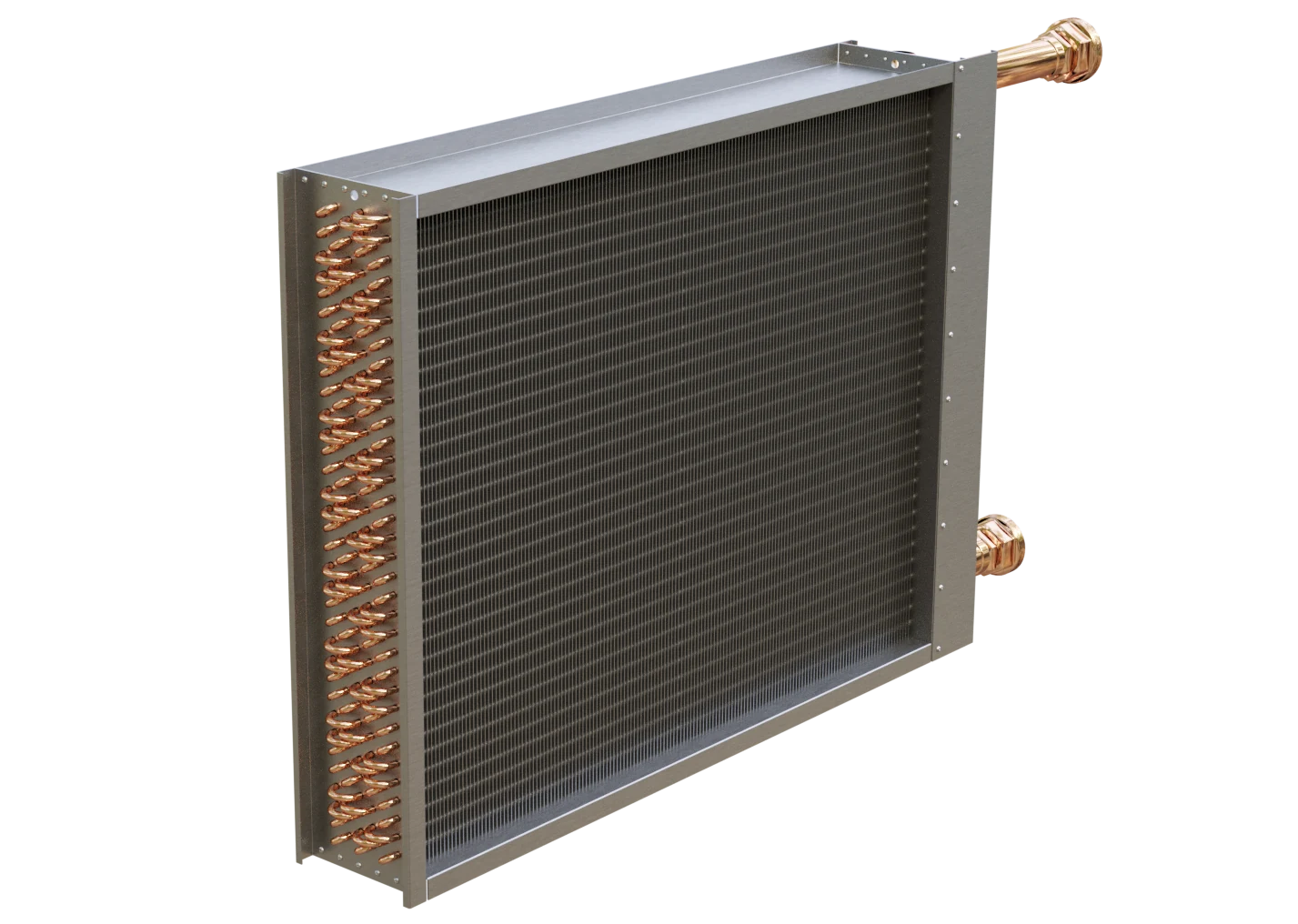
UPGR archive 3D visualization of a liquid coil. The view shows the finned surface and return bends; dimensions, fluid and internal circuits are specified for the project.
01
The coil within the air handling system
In a finned-tube coil, water flows through the tubes while air passes over the heat transfer surface. The coil does not define the complete system: the fan, water-side connections and controls have separate functions. Identify the scope of the enquiry: a coil, a replacement for an installed section or selection for new equipment.
IN PRACTICE
How heat reaches the supply air
Follow the heat path. The water circuit and the air passage are separate.
01
Hot water
Operating temperatures and flow rate.
02
Tubes + fins
Heat passes through the tube wall to the finned surface.
03
Supply air
Air passes over the fins and warms up.
This is a heat-transfer path, not a piping diagram. Frost protection and connections require a separate design.
02
Heating duty and pressure drops
Airflow and entering air temperature establish the starting condition; the required leaving temperature defines the heating target. On the water side, state the available temperatures and flow rate where known. Air-side and water-side pressure-drop limits are separate constraints: the geometry must suit both the duty and the surrounding system.
03
Installation and freeze protection
Check installation dimensions, airflow direction and connection positions alongside the operating duty. Freeze protection involves the coil, hydraulic arrangement and controls; the name water heating coil does not imply built-in protection. For an existing unit, photographs of the connections and installation help relate the duty to the actual mounting arrangement.
REVIEW THE RESULT
What to check in a heating coil selection
One operating point
Compare capacity and leaving air temperature at the same airflow and water temperatures. The selection sheet should identify the input conditions, resulting performance and any assumed values.
Pressure drop on both sides
Set separate air-side and water-side pressure-drop limits. The selection result should report both at the same operating point: meeting the heat duty alone does not establish compliance with these limits.
Connections and protection
Agree the connection side, airflow direction and service access. Record which piping and freeze-protection components belong to the project and supply scope; the coil image does not establish their inclusion.
SELECTION INPUTS
Inputs to prepare
Airflow and entering air temperature.
Required leaving air temperature or heating duty.
Entering and leaving water temperatures; flow rate if known.
Separate allowable air-side and water-side pressure drops.
Available space, airflow direction and connection positions.
For replacement: the nameplate, an overview and a drawing or measurements.
What do you need to do?
Select a new coil
Define operating conditions first. The input checklist above describes the data needed for this application. The enquiry form adapts to the selected duty; it does not calculate a coil rating.
Add the equipment nameplate, photographs, overall and finned dimensions, airflow direction, connections and access constraints. Matching the envelope alone does not confirm performance or compatibility.
Separate fixed interfaces from dimensions open to change. Attach the current drawing revision, duty points, material requirements, quantity and acceptance criteria. Manufacturing feasibility is confirmed for the specific specification.
Final performance, materials and compatibility require a project-specific selection and an approved drawing.
Questions about this application
Are a water air heater and a heating coil different products?
In this context, both terms can describe the same water-to-air heating section. Verify the construction, working fluid and scope of the assembly rather than selecting by terminology alone.
Can a coil be selected from dimensions alone?
Dimensions define an installation constraint. Assessing thermal performance also requires the air and water operating conditions; replacement additionally requires checks of the connections and original construction.
What changes if glycol is used instead of water?
State the solution type and concentration. Performance and pressure drop must be checked for that fluid; a result established for water cannot automatically be transferred to a different mixture.