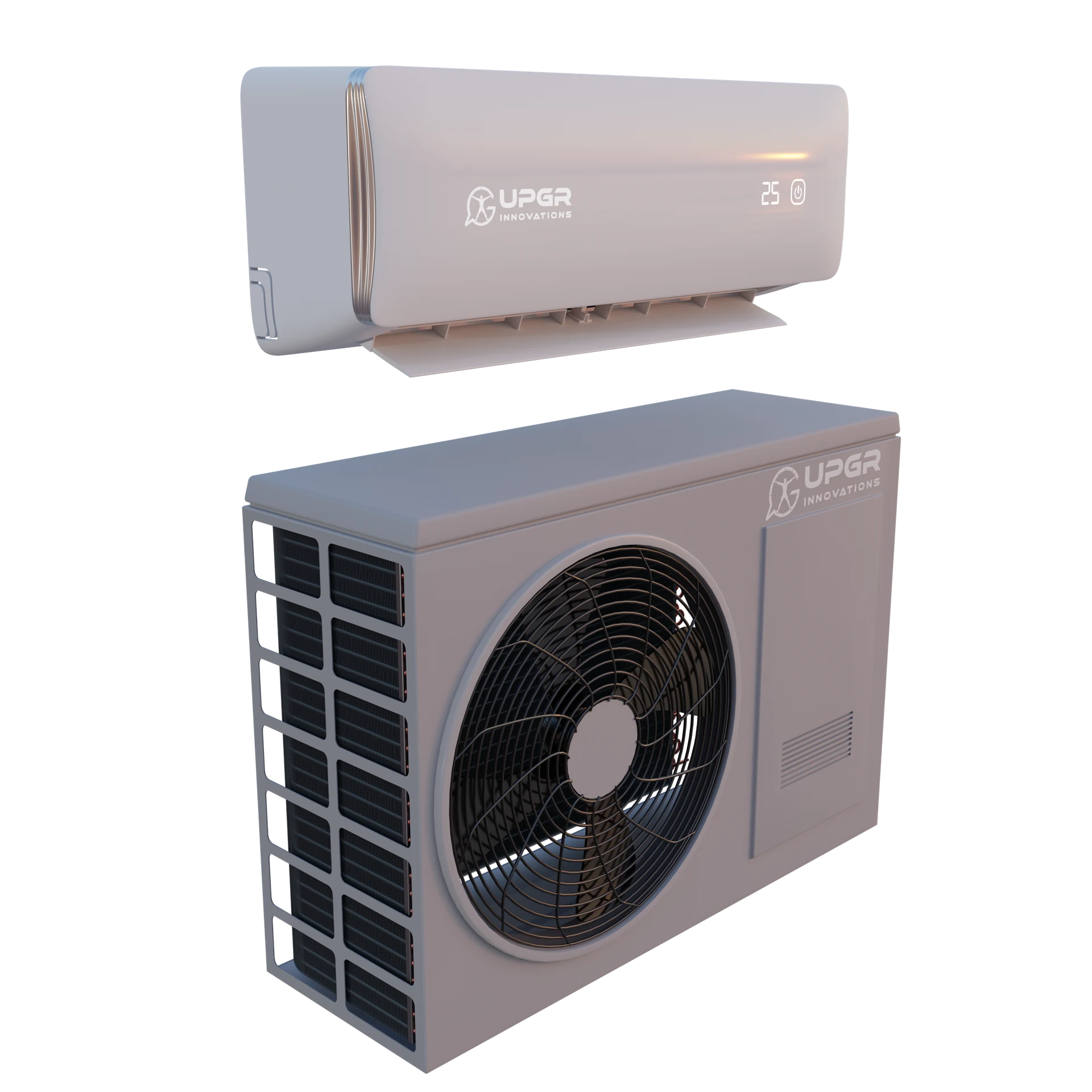
For a replacement coil in a paired indoor and outdoor unit, provide both models and identify the affected unit. If one outdoor unit serves several indoor units, use the multi-split guide. Identify the coil function for each operating mode.
UPGR archive 3D split-system example: one outdoor and one indoor unit. Compatibility, capacity and installation details are specified separately.
01
Indoor and outdoor units
A split system connects separate units through refrigerant pipework. In cooling, the indoor coil normally acts as the evaporator while the outdoor coil rejects heat. In a reversible system their duties change with operating mode, so retain the model and specific coil duty in the enquiry.
IN PRACTICE
One outdoor and one indoor unit
The archive composition establishes the system context before discussing an individual coil.
01
Specify the block
Identify whether the enquiry concerns the indoor or outdoor unit.
02
Identify the model
Provide the model plate, coil photographs and available dimensions.
03
Confirm the circuit
Match the required section to the equipment documentation and refrigerant.
The render illustrates a system arrangement; it does not establish model compatibility, capacity or installation limits.
02
Compatibility of the matched system
Matching dimensions or nominal capacity does not establish compatibility with the compressor, refrigerant metering and controls. Start with the original component identity and manufacturer information. Assess an alternative construction separately against the medium, design and operating modes of the matched units.
03
Coil shape and interfaces
Record flat or bent geometry, fin-pack dimensions, headers, fixings and sensor positions. The indoor coil must interface with its fan and drain pan; the outdoor coil with its airflow path and casing. An overall photograph does not replace measurement of the specific section.
04
Operating modes after replacement
Identify cooling, heating and defrost where provided by the manufacturer. Use the system documentation for refrigerant and operating limits. Replacing a coil does not itself approve a different refrigerant or a modified control sequence.
REVIEW THE RESULT
What to check for a split-system coil
Matched-system identity
The proposal must identify both models and the replacement part. Check compatibility with the original compressor, metering and controls; capacity and shape alone are insufficient.
Function in each mode
Separate the manufacturer's cooling, heating and defrost modes. Do not assign permanent condenser duty to the outdoor coil without considering reversal, or assume a refrigerant change is part of replacement.
Shape and interfaces
Check coil bends, headers, connections, fixings and sensors on one agreed view. Also verify the drain pan and fan position for an indoor coil, or the air path and casing for an outdoor coil.
SELECTION INPUTS
Inputs to prepare
Models and nameplates of the indoor and outdoor units.
Affected unit, component part number and reason for replacement.
Refrigerant and specified cooling, heating and defrost modes.
Coil shape, dimensions, connections, fixings and sensor positions.
Photographs of the drain pan, fan and surrounding casing.
Available documentation and original refrigerant-circuit diagram.
What do you need to do?
Select a new coil
Define operating conditions first. The input checklist above describes the data needed for this application. The enquiry form adapts to the selected duty; it does not calculate a coil rating.
Add the equipment nameplate, photographs, overall and finned dimensions, airflow direction, connections and access constraints. Matching the envelope alone does not confirm performance or compatibility.
Separate fixed interfaces from dimensions open to change. Attach the current drawing revision, duty points, material requirements, quantity and acceptance criteria. Manufacturing feasibility is confirmed for the specific specification.
Final performance, materials and compatibility require a project-specific selection and an approved drawing.
Questions about this application
Is the outdoor coil always a condenser?
No. In a reversible system its function depends on operating mode. Identify its location together with its duty in the operation being considered.
Will any coil with the same capacity fit?
No. The matched units, construction, connections and controls need checking. Nominal capacity does not describe compatibility across those elements.
Can the coil and refrigerant be changed together?
That is a separate system modification and cannot be justified by a coil replacement alone. Start the enquiry with the original refrigerant and manufacturer limits.